In March, the Government provided an update on its New Towns strategy following its response to the New Towns Taskforce report of September 2025. But there is a major unanswered question: how will the infrastructure needed to support these New Towns actually be financed?
The Infrastructure Challenge
Roads, rail, utilities, schools and other infrastructure must be built before homes are occupied, creating a substantial financing challenge. It has been estimated that the infrastructure cost per New Town of 10,000 homes is in the region of £4bn. Some of the New Towns are expected to have more than 40,000 homes, which will drive up infrastructure costs considerably. Furthermore, infrastructure often has to be delivered at a larger scale to generate a positive net present value for the project. My own estimates (from assessing projects across city-regions where demand for housing is high) indicate upfront infrastructure costs are likely to be between £4bn-£13bn.
Although there has been no specific announcement on how the Government is planning on funding and financing the seven announced New Towns, it did announce its infrastructure strategy in June 2025. This implies the use of a mixture of Government grants, as set out in the Spending Review, alongside Public Financial Institutions such as the National Housing Bank (NHB).
The core problem for any Government trying to fund infrastructure is to solve for the “maturity mismatch problem”, and to do it without damaging the public finances. New Towns require billions of pounds of investment upfront, but many of the revenues they generate only arrive over decades.
Various solutions to this problem have been successfully deployed since the 19th century, when public corporations issued long term debt backed by identified hypothecated cash flows to pay back the bond holders.
For example, 40-year bonds were issued by the Metropolitan Board of Works to finance Bazalgette’s sewer system for London. The Central Electricity Board in the 1920s issued debt at similar maturities to pay for the National Grid. The post-war New Towns borrowed at 40-year maturities from the Public Works Loan Board during the 1950s and 1960s.
This method has been copied widely across Europe since. The Oresund Bridge linking Denmark and Sweden issued debt with a payback period of 50 years, building out between 1995 and 2000. When Paris embarked upon the Grand Paris Express (a major project to improve public transport and open up new areas for housing) in 2010, they issued debt of up to 40 years.
In all these cases, the infrastructure was delivered swiftly and bondholders were paid back from long term hypothecated revenue streams. Typical revenue streams include land value capture from selling plots with planning permission, business rates and revenue from car parks, affordable housing, transport and utilities.
This approach also improves the public finances. It delivers infrastructure (which is vital to boosting productivity growth) while not placing any claims on future tax revenues. Instead, because these projects generate their own long-term revenues, they can repay the borrowing that was required to build them. This reduces the need to issue sovereign debt, maintaining lower government borrowing costs for current government expenditure.
Why the Government’s Strategy Falls Short
Despite the successful use of this mechanism to build large swathes of the UK’s infrastructure, governments since 1992 have pushed for a combination of government grants in conjunction with loans and subsidies to enable private projects to get off the ground. But this approach struggles to solve for the “maturity mismatch problem” (where projects have high short-term costs with longer term revenue streams) – hence the Rachel Reeves’s decision to propose a Public Private Partnership for New Towns. This approach will come up against significant barriers.
First, the increased capital investment earmarked in the 2025 Spending Review for Ministry of Housing, Communities and Local Government (MHCLG) and Department for Transport (DfT) already appears to already be allocated: the bulk of the additional MHCLG grant will support the Social and Affordable Homes Programme while £15.6 billion has been allocated to transport for Northern elected mayors. Hence, it is highly unlikely to be allocated to New Towns.
Second, there is very limited fiscal headroom for the Government to issue more gilts. With Government debt to GDP close to 95%, gilt investors are increasingly wary of further issuance given the declining demand for gilts. This is one reason why gilts have become so volatile in the face of external shocks – and also explains why so few European governments use this approach for infrastructure.
Third, although the Government’s Infrastructure Strategy allocated £16bn of financial capacity to the NHB (a mixture of loans, equity and guarantees) the Treasury’s own forecast for the use of Financial Transactions (Table B4) from now until 2029-30 indicates MHCLG will only use £5.4bn of capacity, while the Department for Transport will use none. The Government only expects to use a third of the capacity of the NHB. This will also mean the amount of private sector capital that can be crowded in will be significantly lower, and insufficient to allow a PPP approach to work. There is also little evidence that similar arrangements through Private Finance Initiatives have delivered good value for money in the past.
The current approach is therefore wholly unsuited to delivering the upfront public infrastructure the New Towns need if they are to be successful. There is not sufficient grant funding available, and the Government’s public private partnership (PPP) does not work at scale by the Treasury’s own admission. Where the PPP approach can work is for small-scale private projects that need a government subsidy to get off the ground. An example is the redevelopment of Brent Cross, where the developer was provided with a £100m subsidised loan alongside a £500m grant and a £140m Homes England loan to enable more than 6,000 new homes. But it would not work for 40,000 homes.
A Better Way Forward
This is why a group of investors managing about £2 trillion in assets wrote to Rachel Reeves in February, expressing their interest in buying public corporation debt to pay for New Towns including along the OxCam arc. These bonds provide good returns for investors, will help drive productivity growth, and place less pressure on the public finances, as they are self-funding.
Yet rather than doing what has worked well elsewhere, and in the UK in the past, the stated approach will struggle to scale, place greater pressure on the public finances and keep gilts volatile during periods of stress. Unless the financing model changes, the Government risks repeating a familiar pattern: ambitious plans that never achieve the scale originally promised.
This article is reproduced here with the kind permission of the Bennett School of Public Policy, on whose website an original version appeared in April 2026.
Andy Burnham’s commitment to deliver the biggest programme of council and social housebuilding since the post-war era is both ambitious and hugely welcome.
For the millions of people trapped in England’s housing crisis, including the 176,000 children growing up in temporary accommodation, that ambition cannot come soon enough.
The good news is that momentum is already building. Thanks to decisions already made by the Government, councils and housing associations increasingly have the confidence, funding and policy certainty to ramp up delivery of social rent homes. NHF figures show a 57% increase in social rented homes started last year.
These are the green shoots of a renaissance in social housebuilding. But they are fragile and progress could easily stall. To sustain momentum and translate ambition into delivery, there are two immediate steps the new Prime Minister could take.
The first is to immediately confirm successful bids for Strategic Partnership funding under the Social and Affordable Homes Programme (SAHP). These bids have been submitted and assessed and are now awaiting political approval before they can be announced. Councils and housing associations have schemes waiting, planning secured, and just need the funding confirmed to get building tens of thousands of homes. A summer of delay and uncertainty on grant funding could bring the current momentum to a halt. This creates a real risk that providers will be forced to delay, scale back or even abandon development opportunities, ultimately leaving families trapped in unaffordable temporary accommodation or private rent for longer.
The second is to top up the funding for this and subsequent years of the SAHP – either via redirecting existing budgets immediately or via new funding at the next fiscal event. The £39bn for social housing announced at last year’s spending review was a generational shift in support, but it is spread over 10 years, with the funding profile weighted toward later years, while many schemes are ready to proceed now.
We could build more homes, more quickly, on schemes that are ready to go, if more funding was available early on, for both Continuous Market Engagement and Strategic Partnership funding routes.
Doing these two things immediately would sustain momentum, get spades in the ground and more households into desperately-needed social rent homes as quickly as possible.
There are opportunities to go much further, to deliver the increase in social housebuilding we need, whether through seizing the opportunities of devolution, New Towns, Land Value Capture, reforming council housing debt rules, or exploring new models of public ownership. Councils and housing associations stand ready to work alongside communities and the government to unlock these opportunities, but they will take time to bear fruit. In the meantime, we must maintain and accelerate the progress already being made.
England’s housing crisis is one of the defining social and economic challenges of our time. It damages life chances, drives homelessness, places unsustainable pressure on public services and undermines economic growth. The government has laid important foundations for a new era of social housebuilding. The priority now is to turn that ambition into delivery – building more homes, more quickly, for the people who need them most.
Britain needs more homes. We should use policy to get empty homes back into use and to encourage people with extra space to downsize – but that won’t change the fact that the UK has been under-delivering homes for decades compared to other Western countries.
Yet our housing crisis is not just a crisis of low supply. It is a crisis of overdependence on a single model of supply. For decades, we have relied overwhelmingly on speculative private development. Developers buy land assuming they will build market sale homes for the highest prices possible in a given local market. They then wait as long as necessary to sell at the prices they assumed when buying land. When prices fall or build costs increase, as they have done recently, supply slows. That is not a moral failing: it is how the speculative development model is designed to work.
The planning system bakes in this housing model, taking for granted that this is how the majority of homes will be delivered, and seeking to cream off some of its profits to build social housing and infrastructure (via Section 106 agreements in England and Wales, and Section 75 agreements in Scotland). No resilient country should rely so heavily on one delivery model for something as fundamental as housing.
There are two basic theories at play in the debate about how to increase housing supply in the UK:
Make this speculative development model as easy, smooth and profitable as possible
Diversify the UK’s housing supply away from this one over-dominant model of housing supply
I would argue it is self-evident that the gains from the first strategy are bound to be too limited to make a difference to most people’s lives. Reforms to planning and regulation matter. Britain does need a faster, more predictable planning system. But planning reform alone cannot solve a housing crisis rooted in overdependence on a single speculative delivery model that relies on maintaining prices where they are. Since current prices are far too high for most people to afford, this supply model will only ever be able to cater to a minority. Increasingly, it sells homes to first time buyers with support from the so-called ‘Bank of mum and dad’. For the rest of us, our only possible hope of buying an average priced home in England is to be in the top 10% of earners in the country.
Now let’s explore the second strategy: free the UK from over-dependence on the speculative model. Healthy housing systems use many delivery models at once: private sale, social housing, community-led housing, Build to Rent, co-operatives and specialist housing for older people.
The most direct way to diversify how we build homes is to use the tried and tested model of mass social housebuilding – as discussed in Labour Housing Group’s 2020 report, The Missing Solution. Policy and funding support must enable councils and housing associations to ramp up supply. To scale up social housebuilding anywhere close to the levels needed, we need two things.
Public grant and affordable finance to cover the costs of building homes, so that rents can be kept low and affordable for social renters and homes can be managed and maintained to decent, safe standards.
It is a moral and economic imperative for governments across the UK to scale up this model as much as humanly possible, as fast as humanly possible. We can and must do more – for example on affordable land supply, front-loading grant, extending low-cost loans, building capacity in councils and community-led housing groups, and supporting acquisitions from the market.
But after 14 years of Conservative misrule of our economy, aggravated by war and international turmoil, it is difficult to see how the UK can scale up social housebuilding as quickly as we need to confront our housing crisis in the way that people deserve. It is going to take time to rebuild social housebuilding after decades of hostile policies.
I don’t want to ask people to wait. I want us to use every tool in the box to get every person in this country in a safe, affordable, decent place to call home. That means using policy to support as much diversification of housing supply as possible:
Build to Rent helps keep supply going when speculative development stagnates, because it does not rely on households being able to get a mortgage. While new-build private rented homes tend to be let to renters with higher incomes, this can free up existing – often more affordable – homes for other renters in the same community.
Tackling the chronic shortage of specialist housing for older people will mean more people have a safe, accessible homes as they age – and will also free up homes for people who don’t have those same needs.
Purpose-built student accommodation – at the right levels and in the right places – can make more existing homes available for local people in university towns and cities.
None of these alternative private development models alone will solve the housing crisis – but done right, they can all help. All have untapped potential to provide more ‘Affordable Housing’ through planning agreements.
I understand why many on the Left are sceptical of new profit-driven development models. But there is no doubt they are playing an important role in diversifying housing supply in other countries with similar housing problems to our own. Britain’s housing crisis is too deep, and too urgent, for ideological purity or single-solution thinking.
We must build far more social housing. We should reform planning. We should support community-led housing. We should use Build to Rent, specialist housing and student housing where they help free up supply elsewhere.
The goal is not to defend one development model against another. The goal is to create space in our housebuilding system for every model that can contribute to ending the housing crisis.
There is a growing consensus that something has fundamentally gone wrong at all levels with housing in Britain. We often search for new approaches and policies to meet society’s needs when in fact we should instead look at our history for the solutions.
The Labour Government understands that the housing market is dysfunctional, that housing supply for decades has been inadequate and is rightly appalled at inheriting a situation where there are over 300,000 people, including more than 170,000 children, in all forms of temporary accommodation. In this context, the response to set an ambitious target of 1.5 million new homes over 5 years is appropriate. I am, however, concerned that even with a record £39 billion committed to the affordable housing programme, this will not produce anywhere near enough truly affordable homes, and in particular, the right kind of social rent homes to meet the crushing levels of housing need.
My worry is that in a drive to hit house building targets we lose sight of something of enormous importance, and that is the need to create communities where people want to live and want to put down roots.
This is where looking at our history becomes so important. During the inter-war years of the early twentieth century, and then in the post second world war period, pioneering planners and local authorities in Britain, despite the most challenging of circumstances, created garden cities and new towns that have stood the test of time.
The Dagenham and Rainham constituency that I represent contains much of the Becontree housing estate started in the 1920s. The planners of the London County Council had the foresight to adopt much of the thinking that inspired the earlier garden city movement. Building 2, 3 and 4 bedroom houses with gardens, in an area where parks and other green public spaces were created, gave life changing conditions for families moving from slum tenement blocks in east London.
The housing supply of the last decade or two has been driven, predominately, by the targeting of numbers and by building viability arguments from developers. This has resulted in the over-supply of 1-bedroom flats and a nearly complete absence of 4-bedroom properties.
Instead, we must treat building as a part of place making. We must consider nurturing sustainable communities which are more balanced, incorporating the essential social and transport infrastructure needed to support new and existing communities.
That would also mean changing the housing mix in terms of tenure and house sizes and to build sufficient numbers of homes suitable for families. It would mean building specific accommodation for elderly people designed to promote and extend independent living. This would in fact save revenue spending on social care and demands on health services.
I strongly suspect that this model of housing development would not just have greater longevity than the high-rise apartment block estates do, but would engender much higher levels of wellbeing, with all of the positive social and health outcome benefits that flow from it.
It would also not surprise me if this approach reduces opposition from existing communities to new housing schemes. This would also save planning expenses and time, and give a greater feeling of ownership and of being done by, rather than done to.
As a nation we did this before and did so in even more financially challenging times. Not only that, but those places and homes have stood the test of time.
Building for the future means planning neighbourhoods around the flow of life. From having the infrastructure to provide the best start in life, affordable first homes, places to work and socialise, family sized homes for social rent where people can put down roots, to sheltered options where people can grow old in the community they call home.
Only a legacy plan will help us surmount the housing crisis, not a dash for units.
‘The national project to make housing more affordable is focused entirely on increasing supply [and] … The plan for meeting the supply target is to change planning laws and allow more density in middle suburbs…’ So wrote revered Australian economic analyst, Alan Kohler in 2025.
Especially when it comes to the official narratives accompanying national housing policy in the 2020s, similar comments could be made for other countries including Canada and the UK, to name but two.
Even so, Kohler’s pithy summary underplays the diverse range of approaches that governments are nowadays deploying in their housing supply-focused efforts.
Moreover, while largely centred on planning reform and other ‘market enabling’ measures, initiatives in Canada and Australia now include direct commissioning and funding of housing construction on a scale without recent precedent.
To identify internationally adaptable approaches to boosting housing supply, our new study compared the post-pandemic housing market challenges and policy approaches of Canada and Australia, two of the world’s most comparable nations.
Structural factors
In both countries housing affordability challenges have come to the fore in policy and political debate since the 2010s, with rising house prices and rents generally outpacing incomes. Thus, Canada’s national house price-to-income ratio rose from under 4.0 in 2003 to 7.7 by 2022, with a similar increase observed in Australia.
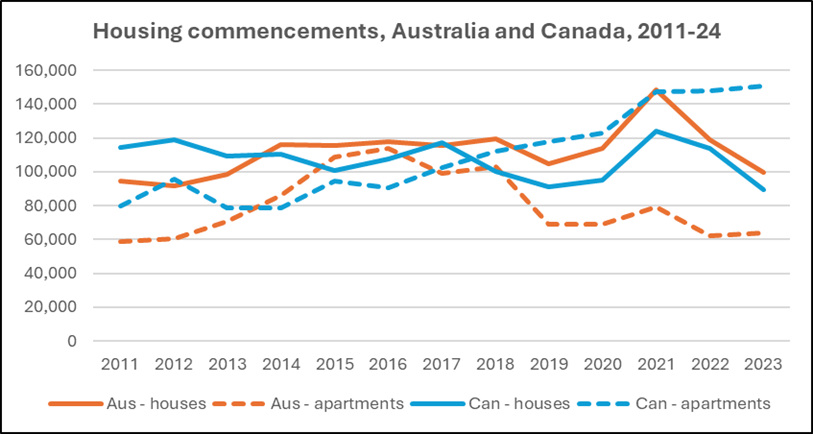
At the same time, the nature of the housing supply challenge in the early 2020s contrasts significantly across the two countries. Most notably, trends in apartment construction have markedly diverged. By 2024, such building starts had fallen by 48% from their 2016 peak in Australia, whereas Canadian unit commencements had surged by 71% over this period.
The main explanation for this contrast appears to be the revived vitality of Canada’s purpose-built rental (PBR) apartment industry in the post-Great Financial Crisis era. This is a sector far more strongly represented here than in Australia. Canada’s PBR construction surged more than threefold in the decade to 2024, representing a remarkable 42% of all housebuilding by that date.
As shown by the Canadian PBR industry’s relatively stable output in the immediate post-pandemic era, this speaks to the product’s resilience in the face of challenging market conditions. While abetted by favourable lending and mortgage insurance policies, the main explanation is probably the over-riding priority PBR investors place on long-term rental returns. This leaves them relatively sanguine about short-term market conditions and prospects.
Encouraging planning liberalisation
Efforts to both liberalise land-use zoning restrictions and streamline development approval processes are indeed central to contemporary pro-housing supply efforts in the two countries. However, federal administrations are constitutionally constrained here. Lacking powers to mandate planning policy (controlled by state/territory/local governments), federal influence must be transmitted indirectly.
In Australia this has been recently progressed under the Albanese government via the 2022 National Housing Accord. Central to this inter-governmental agreement was the commitment by signatory federal, state/territory and local authorities to ‘[i]mproving zoning, planning and land release’.
Accord participants also endorsed a national housebuilding goal to construct 1 million new dwellings 2024-29, later upped to 1.2 million homes within that timeframe. The federal government pledged a $AUD3B ‘New Home Bonus’ payable to state/territory governments conditional on achievement of jurisdiction-specific building targets.
Parallel Canadian efforts have centred on the federal Housing Accelerator Fund (HAF), a $CAN4B program to incentivise planning and other relevant reform by local governments. More subtly, HAF payments are intended to support municipalities growing housing supply ‘faster than [the local] historical average’.
As operationalised since 2023, Canada’s HAF program has involved federal-municipal agreements where, in exchange for pledged federal payments, lower tier governments have committed to specific planning reforms and other undertakings to expand housebuilding.
Beyond their status as ‘reward payments’ for relaxing or simplifying land use planning’, Canadian HAF subsidies fund other municipality actions on housing supply. This includes local commitments to channel such funds into affordable housing construction.
Other pro-supply measures
As unpacked in our research, though, pro-housing supply measures in both countries extend well beyond planning liberalisation. As represented to some degree in both Canada and Australia, these include:
Infrastructure funding support
Low-cost debt facilities and development de-risking
Federal property tax reform
Workforce capacity building
Technological development
Government-funded housing production
Identifying and allocating public land for affordable non-market development.
Generally, these interventions have been disproportionately larger and more ambitious in the Canadian case – especially when it comes to de-risking private housing development, and in financial support pledged for pre-fabricated (or ‘modular’) housing construction.
But, while ‘market enabling’ measures remain dominant, recent initiatives have seen both countries also pledging muscular interventions in the commissioning and funding of housing for both sub-market rent and sale. The new Build Canada Homes agency launched by the Carney government is tasked with ‘[constructing] affordable housing at scale’ – including $CAN4B loans and $CAN6B contributions to [non-market] ‘deeply affordable housing, supportive housing, Indigenous housing, and shelters’.
Meanwhile the Australian Government pledged in 2025 to commission 100,000 homes for (ring-fenced) sale to first home buyers over eight years. This revives a practice which contributed significantly to expanding Australian home ownership under the Keynesian consensus of the early post-war period, although subsequently absent for half a century until now.
The modern pre-occupation with expanding housing production while doing little to dampen housing demand remains highly questionable. But the range of pro-supply initiatives proceeding in countries such as Canada and Australia is far broader than the dominant ‘planning deregulation’ narrative implies. These extend to measures that, in their interventionist nature, arguably challenge decades of neo-liberal orthodoxy.
Much like its Australian and Canadian counterparts, the Starmer government’s housing reform narrative has overstated the scope for easing housing affordability through planning reform.
Lessons for the UK
As in those comparator nations, UK governments need to shift away from over-reliance on blanket efforts to boost market supply through development approval deregulation. Instead, taking a leaf out of Canadian and Australian books, the promised national housing strategy for England should embrace a wider range of pro-supply initiatives.
Emulating recent boundary-pushing measures under Premiers Carney and Albanese these measures should include more direct interventions that recall an earlier post-war era when such actions were standard practice.
Hal Pawson is an Emeritus Professor at the University of New South Wales Sydney. Steve Pomeroy is an Industry Professor at McMaster University, Hamilton, Ontario.
A version of this article first appeared on Australia’s Fifth Estate site.
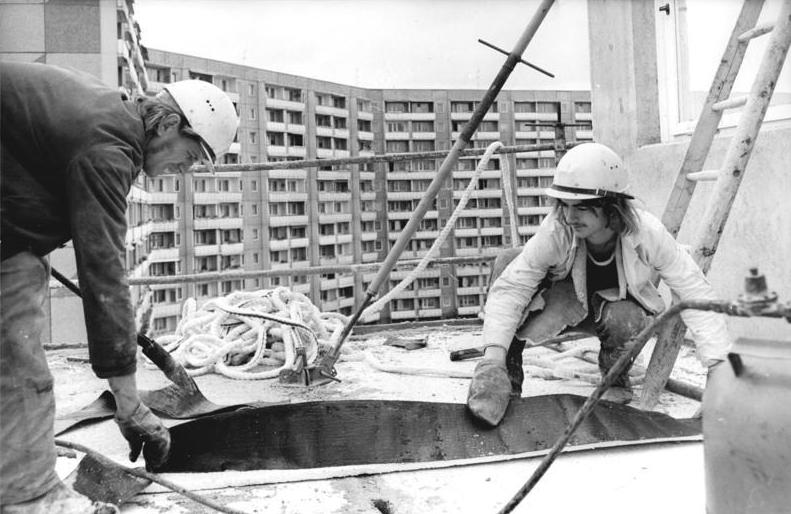
Two construction workers with a block of flats behind them
With 169,000 children growing up in temporary accommodation – the highest number since records began – the case for the government’s manifesto commitment to ‘deliver the biggest increase in social and affordable housebuilding in a generation’ is overwhelming. This situation damages children’s health and development, and it is costing councils across England £7.7 million every day. It is a national scandal whose social and financial costs are well-understood.
But social housing does more than provide an alternative to poor-quality homes. It is also the foundation of a successful housebuilding system. Building social homes at scale – including during market downturns – can underpin the government’s response to the crisis in construction skills and innovation. Far from being in conflict, social housing and market housing can support each other.
The inherent limitations of the UK’s development model
In a housebuilding system which relies excessively on speculative market housing, developers compete against each other to pay the most for land. Having taken on a large upfront risk through high land costs, developers then need to recoup their investment, building as slowly as necessary to maintain prices. But when sales prices soften, even moderately, market housing starts plummet. Developers are not incentivised to start new schemes if they will have to sell homes for less than they assumed when buying land.
To make matters worse, in tandem with increasing dependence on this speculative model of market supply, the UK’s social housing supply model has become pro-cyclical. Post-war social housing developments were close to 100% social housing. Most costs were covered by grant, and land was assembled at low cost outside the speculative market. This model was insulated from market cycles, allowing the supply of social homes to continue during downturns in private housebuilding. In other words, social housing supply at this time was counter-cyclical.
From the 1980s, the dominant supply model for social housing flipped: grant rates were cut, borrowing costs rose, social landlords had to start competing with private developers in the land market. As a result, an expanded range of ‘affordable housing’ tenures (with costs pegged to market prices) has become increasingly dependent on cross-subsidy from the profits of building market housing. Far from smoothing out the boom and bust cycle of speculative private housebuilding, this model of building social housing intensifies those peaks and troughs. This doesn’t just affect how many homes are built. It shapes how the construction sector itself operates.
Supporting the UK’s construction sector
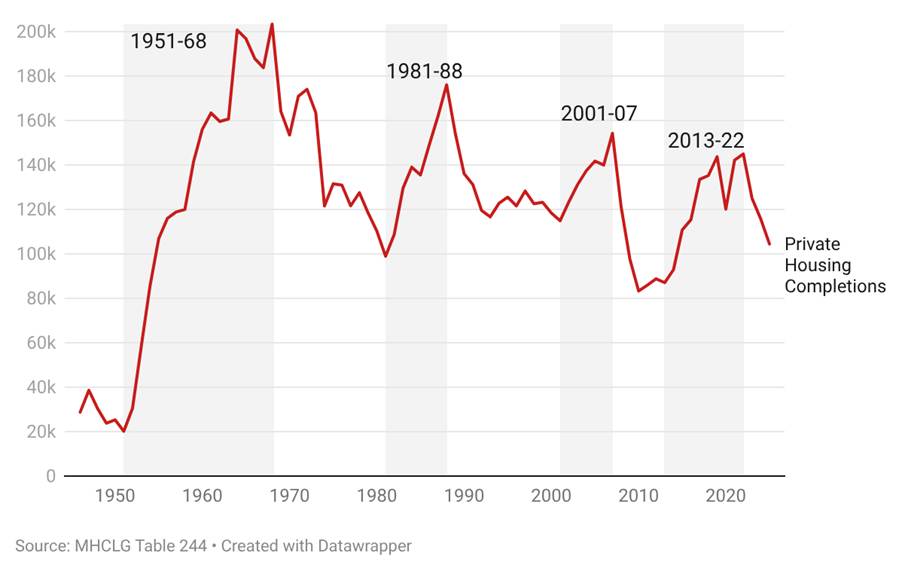
Ratcheting down: Private housing completions in England since 1946
Over repeated cycles of the housing market, the total output of speculative development is ratcheting downward. As housing starts plummet, so too does the demand for skills and materials. Many construction workers simply leave the sector, often permanently. It is no coincidence that construction workers are more likely to be self-employed than workers in any other sector. Today, more people are leaving the construction sector than joining it, and productivity has remained stubbornly flat for decades. Why would housebuilders maintain a large permanent workforce, or invest in the skills of that workforce, when they know they will need to retrench supply as the market turns?
Because firms cannot predict demand, materials prices have become more volatile. Official statistics show sharp swings in construction output and brick deliveries, worsening shortages and price spikes in an import-dependent system. As the construction industry has adapted to manage the risks of cyclical demand, construction capacity has atrophied.
The long-heralded shift to modern methods of construction (MMC) has also stalled. The speculative, stop-start nature of the industry makes the expense and risks of investment in innovation unattractive. Investors are reluctant to commit to factories which will be moth-balled at the first signs of the next housing market slowdown.
From stop-start to build, baby, build
A more balanced system would combine market housing with a counter-cyclical social housing programme, alongside new market models based on stable demand such as Build to Rent.
When governments fund and enable social housing at scale, it can be built as fast as need demands and construction capacity allows. As the Farmer Review of the UK Construction Labour Model found in 2016, a major programme of social housing would support predictability of demand for labour, skills and materials, resulting in a less risky operating environment for housebuilders, developers and planners. The booms and busts of cyclical market supply are smoothed out by counter-cyclical social supply, so capacity can be maintained and increased despite housing market cycles.
In countries such as Japan and Sweden, innovations and new technologies have thrived on this certainty, creating new opportunities to expand development capacity. It is no coincidence that the last time that modern methods of construction made a major contribution to overall housing supply in the UK was during the post-war social housing boom.
Of course, the benefits of a more sustainable skills base and of innovation in construction today would be felt far beyond the developments which first enabled them. If social housing schemes keep construction workers in the sector during market downturns, those experienced workers will be available to the private sector when the market recovers. If social housing schemes provide enough stable demand to keep MMC providers in business, market housing will be able to benefit from their services, too. While construction capacity is often seen as a constraint on building more social housing, the reverse is also true. A stable pipeline of social housing would expand capacity, supporting more jobs, stronger skills, and greater innovation across the sector.
The government’s new Social and Affordable Homes Programme 2026-36 represents the most significant policy shift back towards a counter-cyclical social housing supply model in decades. A future blog will explore how this could work in practice, and what further changes are needed.
In a way, it was almost inevitable that I would develop an interest in gentrification and housing. After all, I am a millennial and I grew up in Zone 2/3 of Inner London. I didn’t just watch my neighbourhood change as I grew up, I watched the door to a future my parents’ generation took for granted close before my eyes.
My parents moved to Forest Hill, South East London in the mid-80s. Even back then my parents couldn’t afford to live in Hackney or Tooting (my mum had been a big Citizen Smith fan). Growing up, South London was the butt of jokes – most of which revolved around it being poorly connected, scary or dull. But by the noughties, my area would start appearing in the aspirational columns about London’s new exciting suburbs. Housing prices rose sharply and continuously. The global housing market crash in 2008 couldn’t stop this runaway train and the last decade has seen my neighbourhood transform.
I noticed the most rapid changes taking place after 2011, when the London Overground was delivered to the area. I was away at university over this period and as I returned each summer, there were new cafes, estate agents and pizza places to replace the launderettes, sandwich shops and second-hand electronic stores. I remember chatting to the owner of Cafe No 41 on Brockley Rise around this period. He had owned Bertie Rooster’s Fried Chicken on the same site and he said he’d noticed the area changing, so he thought he’d better change too. Smart move.
Local NIMBYs, true to form, opposed the transformative rail connections. I remember my dad, who worked in transport, railing against the local opposition to it. He had been arguing for greater capacity for the Overground, for longer trains, and an additional station between Surrey Quays and Queen’s Road Peckham. As the Overground now sits at bursting point — a victim of its own success — he should’ve been listened to. Ironically, the Overgound has been a huge boon to their property-owning NIMBYs that opposed it.
But while I infamously remain sniffy towards NIMBYism, I do understand it. A rapidly changing neighbourhood can be discombobulating and disconcerting. As a strange teenager, I remember pleading with my friends to go to the array of cornershops in Honor Oak instead of the new Sainsbury’s Local if they were buying drinks and snacks before we had a kickabout in the park. Instinctively, I didn’t like what I saw as the homogenisation of my local mini-high street and I knew that Sainsbury’s would destroy some of those independent shops (it did) that I felt I had a relationship with. My instincts were to, in a way, keep my neighbourhood ‘static’.
I’ve been on a journey to try and understand the phenomenon that shaped my home town when growing up and understand my own feelings around it. While at university, I wrote my dissertation on the changing Toxteth and Canning areas of Liverpool. I had grand ambitions to start a university society that would work with the local community to improve ‘Town & Gown’ relationships in the nearby area. Like most of my plans, they crumbled due to a bad attitude and lack of endeavour. The dream ended with me getting into a fight at a Residents’ Association’s ‘cheese & wine’ night and quite literally being thrown out.
However, looking back on the experience, it gave me a good understanding of how gentrification works and was a valuable insight into a world I would later inhabit. Gentrification is an organic process and one seen in major cities around the capitalist world. The cliched but illustrative example is as follows – artists move into an area due to cheap rents and large spaces. They create an artistic community and the area becomes ‘cool’. With it being cool, it then becomes desirable. The greater appetite for the housing then pushes up rents and prices and gradually the area’s demographics shift.
It was once thought that cities would act like a pebble falling into a pond, rippling outwards and decaying inside. Yet from the 1970s onwards the shift has been back into the centre. Some hippies and squatters now own multimillion pound property in areas of our West End. Savvy boomers profited.
The process of gentrification can be sped by developers who see the opportunities offered by a rent-gap to maximise profits. In this, developers are simply capitalising on a saturated housing market and building where demand is. Likewise, ‘gentrifying’ businesses are responding to their new clientele not moulding customers from thin-air and wishes. Cereal cafes and posh chicken shops are a symptom of gentrification, not a cause. Today, many of the anti-gentrification activists I come across are ‘first wave’ gentrifiers themselves, similar if not a bit older than my parents.
While it is an organic process, gentrification does cause profound issues. Sharp rises in the cost-of-living create havoc for low-income families and at its starkest, drives them from their neighbourhood. As I mentioned in my last blog, social homes with secure and affordable rent is a fire-wall against gentrification. But London is increasingly being hollowed out, swathes of North & West London in zone 1 & 2 have become binary and soulless places – the very well-heeled live alongside enclaves of council homes occupying parallel lives. I worry that the evaporation of London’s Little Italy, will eventually happen to our Little Bengal and our Little Portugal.
***
My blood still curdles at a previous generation of local politicians who seemed to actively encourage the gentrification of their neighbourhoods, as a means of improving their patch. Gentrification doesn’t solve poverty, it just kicks it down the road. But for some local politicians, that once seemed enough. Angered by what I saw, I vowed to campaign against it. It signalled my first forays into local politics.
In my last blog, I wrote about Lewisham’s Residents Charter and how we’ve come along way from this era. Like our predecessors, we know that mixed communities are positive for social cohesion and shared uplift. Likewise, we also know that many of our large post-war estates are in need of urgent renewal. However, as an administration led by a new wave of politicians, we’re committed to ensuring that any regeneration produces a net gain in social homes, expanding our gentrification fire-wall in the borough.
Yet I do not remain hopeful for the future. Writing this, I am struck by just how long I was part of the problem and what that says for the future. I was driven into local politics by the anger that while my neighbourhood was being torn up and built back up, none of these homes were for me.
Developers, greedily lining their own pockets, were building ‘luxury flats’. Councils were failing to stand up to them and accepting schemes with pitiful amounts of affordable housing.
It’s been through sitting planning committee as a councillor that I learnt that most of these flats weren’t ‘luxury’. The only thing luxury about them was the unaffordable price. The housing crisis has simply become so insane in London that any market-value home is deemed luxury and therefore out of reach of someone like me — a young person without assets, earning the average London wage.
This situation has bred a culture of cynicism among an entire generation. As we discuss rents at house parties and scoff in frustration at the mere idea of saving for a deposit, we’ve grown suspicious of new housing and growth. Moreover, the council-led schemes of the past have led to a sour taste in people’s mouths. While these schemes, directly reducing social housing, could be an example of top-down gentrification — it would be wrong to view gentrification as a whole, as planted from top-down from developers.
If writing to note to my younger self, I’d be rather pithy. ‘Dear Leo, sick of chain stores and the champagne et fromages under those new flats? Let many, many, more flats just like that be built, so rents and prices round here come down and the demographics that fed those independent shops and the sandwich shop you loved so much, can remain.’ As this article highlights, the forces that drive gentrification ‘do not come from the construction of specific apartment buildings or retail complexes, no matter how many granite countertops or artisanal coffee shops they might contain.’ Increasing supply will lower prices.
***
It is only now that I see how damaging the framing of gentrification as a top-down process, thrusted-upon benign communities by developers, has been.
As a councillor, I have been shocked by the glacial and bureaucratic process of approving new homes in the borough. Not only that, I’ve seen how small interest groups have leant on councillors to reject new homes on spurious grounds.
But this is only the tip of the iceberg. As this Centre for Cities report highlights, our planning system operates like the old Eastern Bloc, rationing supply through a permit system. ‘In both the former Eastern Bloc and the English housebuilding market, firms must apply to planners for a permit, or a planning permission, to get the inputs they need to do business.’
We currently have a system that cannot respond to demand. Developers need to go through the process of receiving planning permission which is slow, often costly and fundamentally uncertain (planners can downsize or councillors can strike down an application, years into the process). This means ‘the amount of land that they can develop tomorrow is fundamentally unknown.’
It is this risk, inherent in our system, that means developers hoard land that has planning permission (or is likely to receive planning permission). As Centre for Cities notes, ‘this ‘hamster-like’ behaviour is rational as it means they will always have land on which those assets can be operating, even if planning permissions temporarily dry up.’ The report also notes:
‘A site that has planning permission or is suspected to have a high chance of receiving planning permission can greatly increase this price, especially near cities and large towns with successful economies and expensive housing’. To illustrative this point, in 2010, agricultural land without planning permission around Cambridge was worth roughly £18,500 per hectare. Once it received planning permission for housing, the value per hectare increased to £2.9m.
Developers must cover these high land costs, and they cannot escape them by increasing production or efficiency as the planning system rations the supply of land they require. They therefore need to pass their land costs onto consumers and sell new houses at high prices.
Developers experience a disadvantage trying to acquire land which can be lawfully developed, they enjoy the advantage of a sellers’ market when selling new properties to consumers due to slow buildout rates. This means that predominantly only big powerful developers can get hold of land which will get large-scale planning permission, and once they have hold it, they can build a slow ‘absorption rate’ keeping house prices high due.
If developers could instead just buy land and develop it without applying for a planning permission, then “planning gain” and thereby the absorption rate would both disappear. The price of land would reflect local demand and, as firms would and could only buy what they immediately needed, they would be forced to build new housing as quickly as possible to outcompete rival firms that could now do the same.
It is our system which creates the circumstances for large developers to be able to buy the rationed land for development and build slowly as they face little competition.
But this isn’t a cry to rip-up the rule book. Local planning frameworks should remain in place and offer clear rules of what can be built and where. However, areas zoned for development should be greatly expanded. As the campaign group Priced Out argues:
‘For the areas that are zoned for development, there should be transparent rules about what cannot be built there — which could include what the developments are used for, and rules on look and feel — with everything that does not contravene these rules allowed. Alongside this we already have extensive national building regulations, rules on the sustainability of developments, and various other regulation which is already in place.’
Priced Out Manifesto | Rules-Based Planning
However, when reaching out to colleagues to express these views and concerns, I receive immediate and blanket push-back. Those I speak to see the bureaucracy of our planning system as a bulwark against lowering standards. They instinctively reject ideas about cutting red tape and increasing competition to raise standards. Developers are the bad guys that need to reined in by councillors, rather than firms rationally gaming a broken system that we uphold.
It has become fashionable across the political spectrum to deny that our housing crisis is linked to a lack of supply. Campaigners against new market-sale homes often point to the fact that the UK has 216,000 long-term vacant homes, which could occupy a sizeable chunk of our 280,000 homeless people, if only they were happy to be bussed to Cornwall or Cleethorpes.
However, rather than suggesting that we do not need to increase supply, our empty homes highlight our nation’s stark housing shortage. In the UK, only 0.9% of homes are long term vacant. In a healthy market, surpluses provide ‘a strategic reserve which they can use to respond to sudden changes in consumer demand.’
Compare our situation to Japan, a nation with an affordable housing market. In Japan, less than 5% of homes are socially rented (here it is around 17%). Across Japan, 5.6% of homes are long-term vacant, while Tokyo the figure is 2.5% – which is a higher share of empty home than in Burnley – other most affordable city in England and the one with the most vacant housing. Suppressing vacancy rates in the UK will only make the situation worse. Instead, we need to build enough to homes to create a healthy surplus.
As I have written previously, the housing crisis cannot be tackled by local authorities building themselves. This blog succinctly nails the issue: The UK’s housing affordability crisis is too little supply, which cannot respond to prices. However, getting Labour Party colleagues and angry young millennials alike to accept that we need developments of market-rate properties on a huge scale in areas of the country where our housing shortage is most acute — will be an uphill battle.
Steam-rolling through reforms won’t work. Instead, we need to start that process of chipping away – gradually building a coalition in support for house building. And maybe one day we can get more people to say yes-in-their-backyard to luxury flats.
Leo Gibbons-Plowright
Leo is a Labour and Co-Op Party Councillor for Forest Hill in Lewisham.