With 169,000 children growing up in temporary accommodation – the highest number since records began – the case for the government’s manifesto commitment to ‘deliver the biggest increase in social and affordable housebuilding in a generation’ is overwhelming. This situation damages children’s health and development, and it is costing councils across England £7.7 million every day. It is a national scandal whose social and financial costs are well-understood.
But social housing does more than provide an alternative to poor-quality homes. It is also the foundation of a successful housebuilding system. Building social homes at scale – including during market downturns – can underpin the government’s response to the crisis in construction skills and innovation. Far from being in conflict, social housing and market housing can support each other.
The inherent limitations of the UK’s development model
In a housebuilding system which relies excessively on speculative market housing, developers compete against each other to pay the most for land. Having taken on a large upfront risk through high land costs, developers then need to recoup their investment, building as slowly as necessary to maintain prices. But when sales prices soften, even moderately, market housing starts plummet. Developers are not incentivised to start new schemes if they will have to sell homes for less than they assumed when buying land.
To make matters worse, in tandem with increasing dependence on this speculative model of market supply, the UK’s social housing supply model has become pro-cyclical. Post-war social housing developments were close to 100% social housing. Most costs were covered by grant, and land was assembled at low cost outside the speculative market. This model was insulated from market cycles, allowing the supply of social homes to continue during downturns in private housebuilding. In other words, social housing supply at this time was counter-cyclical.
From the 1980s, the dominant supply model for social housing flipped: grant rates were cut, borrowing costs rose, social landlords had to start competing with private developers in the land market. As a result, an expanded range of ‘affordable housing’ tenures (with costs pegged to market prices) has become increasingly dependent on cross-subsidy from the profits of building market housing. Far from smoothing out the boom and bust cycle of speculative private housebuilding, this model of building social housing intensifies those peaks and troughs. This doesn’t just affect how many homes are built. It shapes how the construction sector itself operates.
Supporting the UK’s construction sector
Ratcheting down: Private housing completions in England since 1946
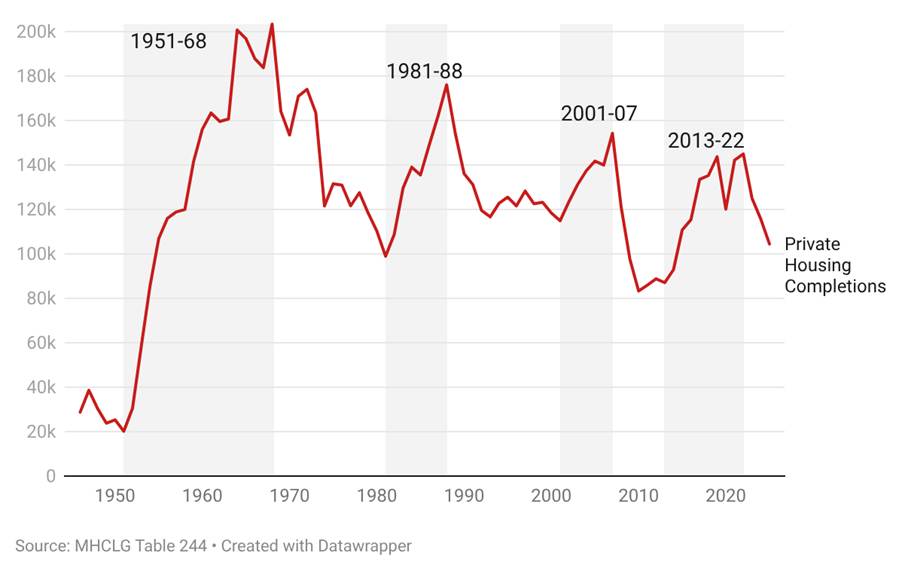
Over repeated cycles of the housing market, the total output of speculative development is ratcheting downward. As housing starts plummet, so too does the demand for skills and materials. Many construction workers simply leave the sector, often permanently. It is no coincidence that construction workers are more likely to be self-employed than workers in any other sector. Today, more people are leaving the construction sector than joining it, and productivity has remained stubbornly flat for decades. Why would housebuilders maintain a large permanent workforce, or invest in the skills of that workforce, when they know they will need to retrench supply as the market turns?
Because firms cannot predict demand, materials prices have become more volatile. Official statistics show sharp swings in construction output and brick deliveries, worsening shortages and price spikes in an import-dependent system. As the construction industry has adapted to manage the risks of cyclical demand, construction capacity has atrophied.
The long-heralded shift to modern methods of construction (MMC) has also stalled. The speculative, stop-start nature of the industry makes the expense and risks of investment in innovation unattractive. Investors are reluctant to commit to factories which will be moth-balled at the first signs of the next housing market slowdown.
From stop-start to build, baby, build
A more balanced system would combine market housing with a counter-cyclical social housing programme, alongside new market models based on stable demand such as Build to Rent.
When governments fund and enable social housing at scale, it can be built as fast as need demands and construction capacity allows. As the Farmer Review of the UK Construction Labour Model found in 2016, a major programme of social housing would support predictability of demand for labour, skills and materials, resulting in a less risky operating environment for housebuilders, developers and planners. The booms and busts of cyclical market supply are smoothed out by counter-cyclical social supply, so capacity can be maintained and increased despite housing market cycles.
In countries such as Japan and Sweden, innovations and new technologies have thrived on this certainty, creating new opportunities to expand development capacity. It is no coincidence that the last time that modern methods of construction made a major contribution to overall housing supply in the UK was during the post-war social housing boom.
Of course, the benefits of a more sustainable skills base and of innovation in construction today would be felt far beyond the developments which first enabled them. If social housing schemes keep construction workers in the sector during market downturns, those experienced workers will be available to the private sector when the market recovers. If social housing schemes provide enough stable demand to keep MMC providers in business, market housing will be able to benefit from their services, too. While construction capacity is often seen as a constraint on building more social housing, the reverse is also true. A stable pipeline of social housing would expand capacity, supporting more jobs, stronger skills, and greater innovation across the sector.
The government’s new Social and Affordable Homes Programme 2026-36 represents the most significant policy shift back towards a counter-cyclical social housing supply model in decades. A future blog will explore how this could work in practice, and what further changes are needed.
Would you like to write for Red Brick? Email rose.grayston@gmail.com to pitch your piece (c.600-900 words)