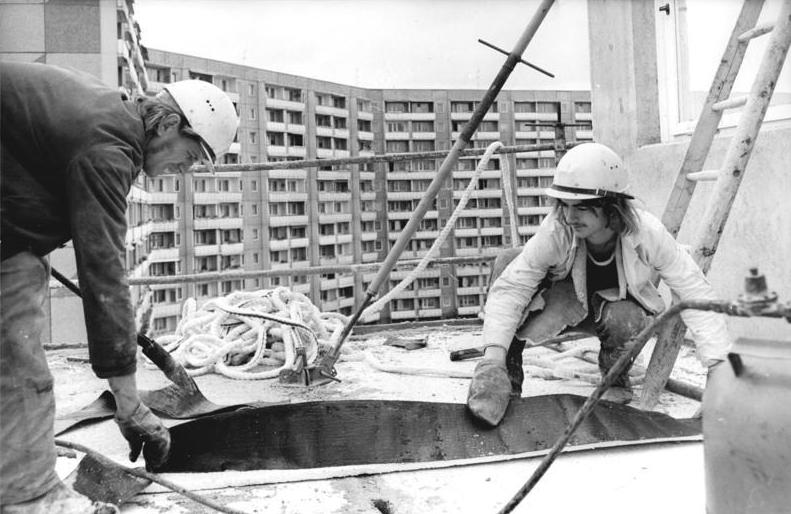
Two construction workers with a block of flats behind them
With 169,000 children growing up in temporary accommodation – the highest number since records began – the case for the government’s manifesto commitment to ‘deliver the biggest increase in social and affordable housebuilding in a generation’ is overwhelming. This situation damages children’s health and development, and it is costing councils across England £7.7 million every day. It is a national scandal whose social and financial costs are well-understood.
But social housing does more than provide an alternative to poor-quality homes. It is also the foundation of a successful housebuilding system. Building social homes at scale – including during market downturns – can underpin the government’s response to the crisis in construction skills and innovation. Far from being in conflict, social housing and market housing can support each other.
The inherent limitations of the UK’s development model
In a housebuilding system which relies excessively on speculative market housing, developers compete against each other to pay the most for land. Having taken on a large upfront risk through high land costs, developers then need to recoup their investment, building as slowly as necessary to maintain prices. But when sales prices soften, even moderately, market housing starts plummet. Developers are not incentivised to start new schemes if they will have to sell homes for less than they assumed when buying land.
To make matters worse, in tandem with increasing dependence on this speculative model of market supply, the UK’s social housing supply model has become pro-cyclical. Post-war social housing developments were close to 100% social housing. Most costs were covered by grant, and land was assembled at low cost outside the speculative market. This model was insulated from market cycles, allowing the supply of social homes to continue during downturns in private housebuilding. In other words, social housing supply at this time was counter-cyclical.
From the 1980s, the dominant supply model for social housing flipped: grant rates were cut, borrowing costs rose, social landlords had to start competing with private developers in the land market. As a result, an expanded range of ‘affordable housing’ tenures (with costs pegged to market prices) has become increasingly dependent on cross-subsidy from the profits of building market housing. Far from smoothing out the boom and bust cycle of speculative private housebuilding, this model of building social housing intensifies those peaks and troughs. This doesn’t just affect how many homes are built. It shapes how the construction sector itself operates.
Supporting the UK’s construction sector
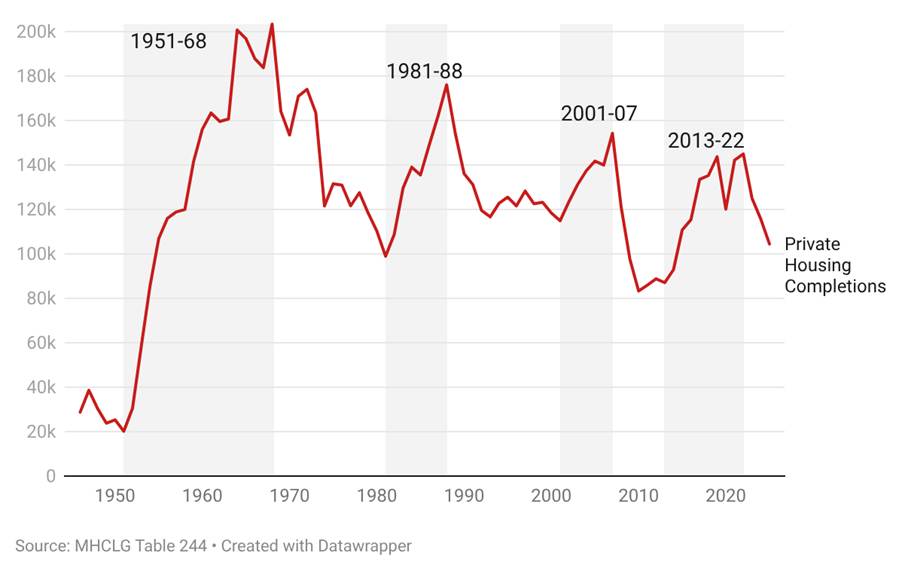
Ratcheting down: Private housing completions in England since 1946
Over repeated cycles of the housing market, the total output of speculative development is ratcheting downward. As housing starts plummet, so too does the demand for skills and materials. Many construction workers simply leave the sector, often permanently. It is no coincidence that construction workers are more likely to be self-employed than workers in any other sector. Today, more people are leaving the construction sector than joining it, and productivity has remained stubbornly flat for decades. Why would housebuilders maintain a large permanent workforce, or invest in the skills of that workforce, when they know they will need to retrench supply as the market turns?
Because firms cannot predict demand, materials prices have become more volatile. Official statistics show sharp swings in construction output and brick deliveries, worsening shortages and price spikes in an import-dependent system. As the construction industry has adapted to manage the risks of cyclical demand, construction capacity has atrophied.
The long-heralded shift to modern methods of construction (MMC) has also stalled. The speculative, stop-start nature of the industry makes the expense and risks of investment in innovation unattractive. Investors are reluctant to commit to factories which will be moth-balled at the first signs of the next housing market slowdown.
From stop-start to build, baby, build
A more balanced system would combine market housing with a counter-cyclical social housing programme, alongside new market models based on stable demand such as Build to Rent.
When governments fund and enable social housing at scale, it can be built as fast as need demands and construction capacity allows. As the Farmer Review of the UK Construction Labour Model found in 2016, a major programme of social housing would support predictability of demand for labour, skills and materials, resulting in a less risky operating environment for housebuilders, developers and planners. The booms and busts of cyclical market supply are smoothed out by counter-cyclical social supply, so capacity can be maintained and increased despite housing market cycles.
In countries such as Japan and Sweden, innovations and new technologies have thrived on this certainty, creating new opportunities to expand development capacity. It is no coincidence that the last time that modern methods of construction made a major contribution to overall housing supply in the UK was during the post-war social housing boom.
Of course, the benefits of a more sustainable skills base and of innovation in construction today would be felt far beyond the developments which first enabled them. If social housing schemes keep construction workers in the sector during market downturns, those experienced workers will be available to the private sector when the market recovers. If social housing schemes provide enough stable demand to keep MMC providers in business, market housing will be able to benefit from their services, too. While construction capacity is often seen as a constraint on building more social housing, the reverse is also true. A stable pipeline of social housing would expand capacity, supporting more jobs, stronger skills, and greater innovation across the sector.
The government’s new Social and Affordable Homes Programme 2026-36 represents the most significant policy shift back towards a counter-cyclical social housing supply model in decades. A future blog will explore how this could work in practice, and what further changes are needed.
In part two of this three part blog contribution we continue to hear from inside the tent to what extent our planning system is truly representative and democratic. Do cries of ‘social cleansing’ hold any veracity, or does left-wing NIMBYism refusal to accept trade-offs manifest itself to the same effect?
Once upon a time, I would’ve stood on Reginald Street in Deptford in searing anger. Even with the land cleared and the hoardings up, I would still be bitter about what my colleagues had been put through. But today I’ve found myself mellowed. As I watch the diggers at work, laying the foundation for 117 new social homes, I wryly smile to myself. Today, the fight for these homes seems so easy, so tiny, so inconsequential.
The old Tidemill school site on Reginald Road had long been earmarked for the development of new homes. Instead of allowing the vacated site to fester, Lewisham Council agreed to a ‘meanwhile use’ leased and the area was handed over to a volunteer community group to operate. With the land, they created a ‘community garden’.
A ‘community garden’ is a bit of a misnomer, as it conjures up the image of an area open and shared by all in the neighbourhood. In reality, due to a lack of volunteers, by the time of its closure, the garden was overgrown, locked up, and open for a few hours each Saturday. Insiders say that a small clique living on well-heeled streets over in Brockley, operated the site as their own semi-private enclave. No big deal, we felt, because at least the land was semi-utilised.
The trouble only started when the council request the stewardship of the land to be returned so that our long-awaited housing development could get underway. Reneging on their promise to hand back the land when the ‘meanwhile use’ was up, the community group refused to hand over the keys. And thus, the ‘Save Tidemill Garden’ campaign arrived.
It quickly snowballed.
Opposite the development site, sits the Birdnest pub in Deptford. I like the boozer, but if I say it wears its counter-cultural chic a little too earnestly on its sleeve, you might get what I mean. It’s filled with students, old rockers and geezers, and was a perfect local meeting point for the Save Tidemill campaign.
Close your eyes and picture a row of wooden tables, on each one, sits a different segment of the Save Tidemill campaign’s coalition.
Table 1: The founders of the garden, mostly your classic NIMBYs, primarily asset-rich and comfortable. They’ll miss their garden when it’s gone and they don’t want pesky social housing spoiling their Saturday afternoon sun-spot.
Table 2: Assorted Left-wing groups. Nearly all older NIMBYs as well, these lot are driven primarily by political opportunism and they want to find a wedge issue to campaign against the local Labour council (internally in the Labour Party, or externally). For this group, they’ll reject any council-led development programme from the pin-head of ideological grounds. Any development that is not 100% council ‘target rent’ is rejected, even if the private sale properties on-site are necessary to fund the building of the social homes. It means that in reality, they reject any new large-scale affordable house building.
Table 3: Eco-Nimbys, probably Green Party members, you know the ones — the type of people who weep over fallen trees on the HS2 path, despite HS2 being a piece of crucial infrastructure to increase our rail and freight capacity and reduce our over-reliance on private cars and lorries which has a huge knock-on effect on our nation’s carbon emissions and the death of more of your bloody trees.
Table 4: Anarcho-crusties / Green-Black Groups. A bit like the Eco-Nimbys but they are more inclined towards violence towards the man.
The Save Tidemill campaign only got as noisy as it did because Tables 1 & 2 framed the building of this new social housing as corporate ‘ecocide’ and therefore managed to connect with Tables 3 & 4. The campaign itself was risible. Misinformation was spread in the neighbourhood and councillors who spoke up for the scheme were relentlessly attacked. Eventually, the rhetoric spilt over into direct action.
Cllr Joe Dromey, one of the few who were brave enough to face the misinformation head-on, would eventually be attacked on the street by masked protestors. Cllr Paul Bell, who led the scheme, would take his address off the Lewisham Council website out of fear of reprisals. He had been accosted in the street as well, while leaving a council meeting.
But as nasty as the campaign got, I never felt like our plans were in jeopardy. Here were 117 new social homes, as well as 41 for shared ownership and 51 for private sale, replacing a ‘meanwhile use’ garden and an old and dilapidated block at 2–30a Reginald Road. The new green space on the development would be accessible to all unlike the Tidemill Garden, and the tenants of 2–30a Reginald Road would be provided brand new high-quality homes on lifetime tenancies. Those in housing need would be given what they deserved. The case was a no-brainer.
Lewisham Council has a Residents’ Charter that guarantees all residents impacted by a regeneration scheme are given the right to remain on their estate and guarantees an increase in genuinely affordable housing. To me, these guarantees are not only morally right, but they also make political-strategic sense.
Left-wing groups and other opportunist political opponents have desperately and repeatedly tried to leap into our estate regeneration proposals for political gain. And while they may have recruited a few new paper-sellers in the process of campaigning, they have failed to stop any major schemes.
Take the regeneration of Achilles Street, New Cross. Despite a campaign by left-wing NIMBYs spreading fearmongering and disinformation among tenants and leaseholders, an estate ballot returned 73% in favour of the regeneration. The likely outcome of this renewal will be 450 homes on site, with a minimum of 50% of the total homes built being affordable, and a minimum of 35% of the total homes built will be Council-owned homes for social rents.
Similarly, even Lewisham Council’s joint-venture with Grainger to build 324 new homes for rent off Besson Street in New Cross slid fairly comfortably through planning, with the ward’s left-wing councillors speaking in favour of the proposals. On the Besson Street scheme, 65% will be leased at market rent to fund the 114 homes which will be lease at London Living Rent. The scheme also delivered an array of other amenities for the area including a new GP surgery and community space for the New Cross Gate Trust.
The left-wing NIMBY groups rejected Besson Street because London Living Rent is not social housing. Instead, these are genuinely affordable rents set by the average incomes in the Telegraph Hill ward. Each household will sign a secure 5-year tenancy that is automatically rolled-over if they want to remain. In Lewisham, we need to build all sorts of tenures, not just social housing, and these homes are designed and will cater to our key workers who will never be eligible for social housing.
On the hoardings that line Besson Street today, someone has scrawled ‘stop social cleansing’. But in fact, these new homes will help key workers — your nurses, your police officers, your school teachers, remain in our borough near where they work. Even more absurdly, the cries of ‘gentrification’ and ‘social cleansing’ were used for Achilles Street and Tidemill Garden. These schemes offer net-gains in social housing — they are a firewall against gentrification and help low-income families remain in our community.
The left-wing NIMBYs have tried to peddle the falsehood that these estate regenerations are not supplying social housing because the new homes will be provided at London Affordable Rent — which is pegged at 2016 social rent levels. London Council target rent is now £105.87pw for a two-bedroom property, while London Affordable Rent is £158.85pw. The 13 residents of Reginald House who would be offered a new home on the development, would continue to be housed at their target rent. For the 104 homeless families being offered a new home, it’ll be a huge fall in rent and for many, the first time they’ve ever had a secure, decent home for their family.
Affordable housing funding is extremely restricted by an austerity-driven Conservative government. But as this article highlights, in 2016, Sadiq Khan as Mayor of London, managed to negotiate funding from central government for new affordable homes. While funding for social homes, at target rent, were ruled out, the government did agree to fund new homes at Khan’s London Affordable Rent. London Affordable Rent is sent at 2016 target rent levels and is deemed a social rent. While target rent levels have fallen since, year on year – a plan devised by George Osborne to reduce the housing benefit bill — London Affordable Rent has stayed static, that’s caused the disparity.
The long and short of it is that for these homes to be funded and built at all, they’ll need to be at London Affordable Rent. Working with a charitable provider and building at London Affordable Rent was the only way Lewisham Council could get this many genuinely affordable homes built at the Old Tidemill site. For activists, it’s a choice of viable developments, providing social homes at London Affordable Rent, or no new social homes at all. Sadly, I know where some groups would side.
The refusal of these left-wing activists to accept those trade-offs, reveals, more than anything else, just how out of touch they are with the lives of London’s precariat and working-poor. The median rent for a two-bedroom property in Lewisham is £365.75 per week, above the housing benefit cap. Moreover, ‘no DSS’ discrimination remains rife in the private sector. Many of our poorest residents cannot afford the private sector and if they can, they remain in overcrowded sub-par accommodation.
Even if new homes on Achilles Street and Tidemill Garden are more expensive than target rent council homes, they are seismically cheaper and more secure than the private sector. The homeless families moving into these homes will care more about a new chance in life than the fact that a registered charitable provider is supplying them a life-time tenancy and not the council. Nor are they likely to quibble about a rent far more affordable than their temporary accommodation or home in the PRS.
Don’t let perfection be the enemy of the working class.
And that’s why these campaigns do not work and never build traction beyond those four tables. Because their arguments are devoid from the lived-reality of the housing crisis and the trade-offs necessary to build new social housing. Despite our reputation, councillors are not daft. We clock that no young renters joined the chorus against the Tidemill Garden development at our local Labour meetings, even if they did follow the Momentum whip.
During Lewisham Labour’s manifesto working groups in 2017, it was noted that it was our young Momentum members who were the ones most enthused by our Besson Street plans. Not only did they like that the income generated from the scheme would help provide services for our residents, they knew from personal experience how life-changing it would be to move into long-term, stable housing in the private rented sector. Like me, they can only dream of a home at London Living Rent.
Councillors speak to residents in our wards all the time and we know that the overwhelming majority accept schemes like Achilles Street, Tidemill and Besson Street are positive. Of course, we still take precautions — we ensure we engage early on any estate regen project and we ensure the facts of a scheme are widely disseminated. On Achilles Street, we held meet-and-greet drop-ins to tackle misinformation. Yet when push comes to shove, sensitive and policy-compliant council-led schemes to build new social and affordable housing are going to have broad support.
While not as politically-heated as large estate regeneration, smaller social housing developments, such as estate-infills can be trickier. Faced by densification of their area without an offer of a new home, current tenants and leaseholders on an estate often take a ‘what’s in it for us?’ approach to the building of essential affordable housing. Moreover, infills often only remain viable if they are larger in scale than many residents are willing to accept.
However, colleagues, alongside the wider public, accept the trade-offs needed to deliver social housing schemes and policy compliant applications will often be looked upon sympathetically. Broadly, public and institutional support (i.e. amongst the council’s political group) work in tandem. It is why councillors can feel emboldened to champion our promised new social and affordable housing schemes and face down the political pressure from noisy campaigns to abandon policy complaint schemes.
But in the grand-scheme of things, I know that all these battles for social housing are small-fry. Local authorities do not have the resources to purchase new land to build social housing on. The scope of what we can achieve is extremely limited. Despite our good work, we can’t even build enough council homes to replace the ones we continue to lose from right-to-buy.
In short, only the private sector is going to get us out of this housing crisis. While affordable housing programmes have institutionalised support, across the political spectrum market-rate builds are viewed with suspicion. This suspicion leads to a widespread lack of public support for market-rate builds and in my view, this in turn leads to councillors having a pre-disposition to be swayed by NIMBY-campaigns.
In part three of this series, I’ll explain that if we don’t accept this reality, and take a new approach to development, the housing crisis will never be beaten. We need to build a new consensus — one that agrees that a lack of supply (+ building in the wrong places) is causing our housing crisis and that we need market-rate developments at large scales that we cannot deliver without reform.
This is option two, and the only one left.
Leo Gibbons-Plowright
Leo is a Labour and Co-Op Party Councillor for Forest Hill in Lewisham.