Planning has been in the news for all the wrong reasons over the last two weeks, shining a spotlight on the lack of transparency, the influence of vested interests, and the undermining of local decision-making.
As the new Shadow Minister for Housing and Planning it is my job to hold the government to account, to scrutinise and challenge their work. I’m not here to oppose for opposition’s sake, but to try and push the government into the right place, especially in this current Covid-19 crisis. However, if the process of opposition exposes something fundamentally wrong, then the gloves come off. Fair play is a fundamental British value and we cannot have one rule for a privileged few and another for everyone else. The Jenrick affair, coming hot on the heels of the Cummings scandal, is a classic case of “do as I say not as I do”.
The facts are clear. The Housing Secretary Robert Jenrick gave the go-ahead to a contentious redevelopment project in the Isle of Dogs just weeks after he sat next to Richard Desmond, the developer behind the scheme, at a Conservative party fundraising dinner just before the December General Election. Mr Jenrick has admitted that the application was a topic of conversation that night.
In January, the Housing Secretary approved the planning application for the redevelopment of Westferry Printworks in London’s Docklands, despite advice from his department’s Planning Inspectorate and Tower Hamlets Council that the proposals did not contain sufficient affordable housing. The decision by Mr Jenrick to approve the planning application by Northern & Shell on January 14 came just one day before an increase in the Community Infrastructure Levy was due to be imposed by the council at a cost of £40m to Mr Desmond’s company.
Is the timeline of these events merely a coincidence? Because of Mr Jenrick’s refusal to provide Ministry documents about his decision, we don’t know the answer. It’s vital that papers on Mr Jenrick’s decision-making are now made public. The public need to know that government Ministers are not abusing their power to do favours for billionaire friends and Tory Party donors. Mr Desmond’s company, Northern & Shell, the former owner of the Daily Express and Daily Star newspapers, gave the Tory party £10,000 in 2017.
In an astonishing development, after being taken to court by the local authority, Mr Jenrick accepted that his approval of Northern & Shell’s planning application for the Westferry Printworks was unlawful. In March, Tower Hamlets took legal action against Mr Jenrick’s decision, arguing that the timing of his decision appeared to show bias towards Mr Desmond. Indeed, the former leader of the Conservative Group in Tower Hamlets resigned from the party over the affair.
After the court ordered Mr Jenrick’s department to release the documents, the housing secretary accepted his approval of Northern & Shell’s planning application had been “unlawful by reason of apparent bias” – an act which allowed him to avoid disclosing documents surrounding his decision.
This is not acceptable, and certainly not the end of the matter. Not only has the Secretary of State acted unlawfully but he has contradicted the Nolan Principles and further eroded trust in the planning process. I have now written to the Cabinet Secretary requesting that he investigate this matter.
I await a response.
Mike Amesbury
Mike Amesbury is the Member of Parliament for Weaver Vale in Cheshire. He was first elected in June 2017 and is currently the Shadow Minister of Housing, Communities and Local Government.
A couple weeks ago now I was fortunate enough to join an online event, run by the Young Fabians and Labour Housing Group, which featured an in-depth conversation with new Labour Shadow Housing Minister Thangam Debbonaire. Having had fairly limited interaction with her before I was pleased to find Thangam bright, engaging and full of ideas for the future of Labour’s policy on housing and homes.
Whilst the event ended up receiving a write-up in LabourList which provoked controversy over Thangam’s opposition to taking on the ‘Cancel the Rent’ policy that many activists have demanded as a response to the coronavirus outbreak, I was far more interested in what she had to say about owning rather than renting. I felt that the shadow minister touched on something particularly powerful when she said that the left ‘needed to be brave’ in making policy for, and understanding that ‘a great many people want to own their own homes’.
I felt this intervention was a particularly astute one to make because it sometimes feels like the debate we have around housing policy on the left too often ignores that innate desire that so many have, not just to be housed but to feel the sense of pride and control that comes from ownership. It seems that there is an underlying sense on the left that if only we could build enough socially rented housing and make it widely enough available that this might solve the nation’s housing issues at a stroke, however there is a good deal of evidence to the contrary. The desire to own a home of one’s own is deep rooted within the British national psyche. Whilst the Germans for instance are a nation of renters – with only 51.5% ownership rate, overall home ownership in England still stood at 64% as of last year, down off a peak of 71% in 2003 but largely unchanged since 2013-14.
Of course, the issue of access to the ‘housing ladder’ is an inherently generational one, as each new generation in turn needs to be given the assistance that is required in taking their first step. No post-war generation has been more let down in this regard than the people that have come to be known as ‘Generation Rent’. This is the term applied to millions of people aged between 25-40 who find themselves priced out of the housing market, with the average house price in England having risen 173% since 1997, with real incomes for young adults in the same time period having gone up only 19%.
Despite these challenges, the desire for ownership among this group remains high with Property Reporter stating in 2018 that almost half of 25-34-year olds not yet on the housing ladder wanted to be homeowners within the next 10 years. As a member of this generation myself, my sense of this issue was only further sharpened when I recently accepted an offer to work for Pocket Living, an SME developer which delivers affordable homes to first time buyers in London boroughs at a 20% discount. Their schemes have also received support from the Mayor’s office.
Researching them in preparation to take on the role I found it both heartening that they were providing an option for people of my generation to get on that housing ladder, however I was surprised that despite Pocket’s success they remain a fairly unique operator in serving the market, with successive governments having failed to look for solutions nationwide in the way that Sadiq Khan has in London.
In this document, produced to celebrate its 15th anniversary Pocket sets out 15 regulatory changes that its experience of delivery could be useful in improving the market for first time buyers:
These are just some suggestions from an organisation that has a track record of delivery in the area and there will doubtless be many more to come as Labour looks to set the programme on homes that it takes to the nation in 2024. What is certain though is that Labour cannot afford to fail to engage with the dreams and aspirations of voters in this area. There is perhaps a temptation on the left to suggest that getting into policy that promotes home ownership and strays from social renting is somehow a right-wing approach, however it is not remotely clear that both cannot be worked on hand in hand.
For too long, whether going back to Thatcher on Right to Buy or even in the current Government’s First Homes policy, Labour has surrendered ground to the right on the issue of home ownership. Thangam Debbonaire is correct, especially in light of the new challenges posed by fallout from the Covid-19 pandemic, to say that Labour must ‘be brave’ in this area and build a policy prospectus that speaks to people’s desire not just to be housed, but to own a home and make it their own.
Mark Mcvitie
Mark is a communications professional who has worked in political campaigns as well as the financial services and housing sectors. He is a regular on the Young Fabians podcast, discussing the latest developments on the left through a policy and communications lens.
In addition, he sits on the executive committee of campaign group Labour for a European Future and is a member of Labour Housing Group. He has previously written for The Independent and Huff Post UK.
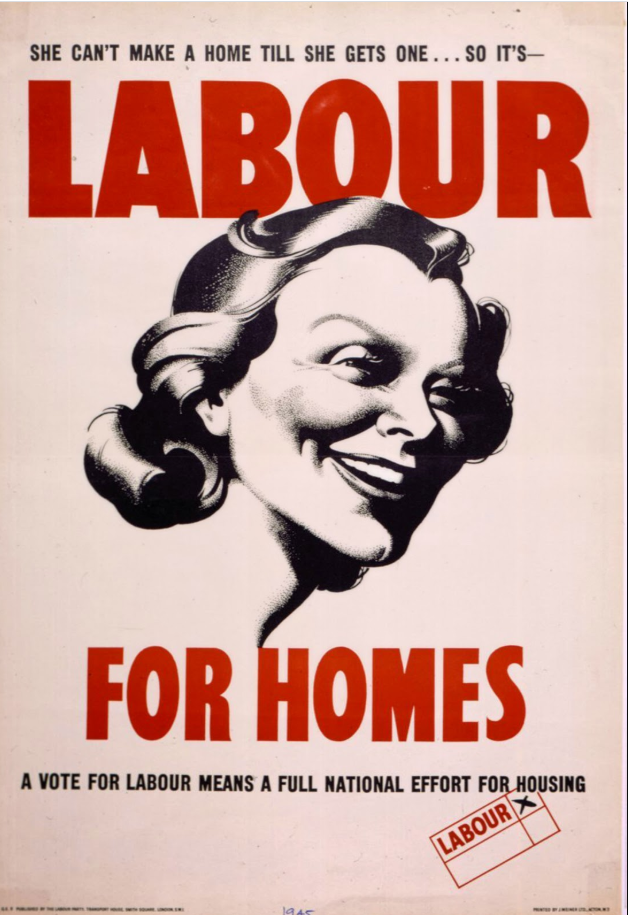
Seventy-five years ago, Britain was in the midst of a General Election that would transform the country for generations to come. And Clement Attlee’s 1945 landslide General Election victory was built on the foundations of Labour’s housing, construction and town planning policies.
To mark the 75th anniversary of Labour’s 1945 General Election victory, Paul Dimoldenberg introduces his new book:
In 1945, the British people took a very practical view of the future. They wanted a decent home, a job and not to have to worry when they became ill or fell on hard times. In short, they wanted a better life and saw Labour as the vehicle through which these aspirations could be achieved.
Labour promised ‘bread and butter’ improvements which secured the votes of working-class and middle-class families. With over 2 million houses damaged or destroyed by the blitz, over half of them in London, the scale of destruction throughout Britain explained the desperate need for new homes. Again, and again, homes and jobs were foremost in the minds of voters. Labour recognized these as the priorities. And the voters believed Labour would provide them. The Labour Manifesto promised:
“Housing will be one of the greatest and one of the earliest tests of a Government’s real determination to put the nation first. Labour’s pledge is firm and direct – it will proceed with a housing programme with the maximum practical speed until every family in this island has a good standard of accommodation. That may well mean centralising and pooling of building materials and components by the State, together with price control. If that is necessary to get the houses as it was necessary to get the guns and planes, Labour is ready.
And housing ought to be dealt with in relation to good town planning – pleasant surroundings, attractive lay-out, efficient utility services, including the necessary transport facilities.
There should be a Ministry of Housing and Planning combining the housing powers of the Ministry of Health with the planning powers of the Ministry of Town and Country Planning; and there must be a firm and united Government policy to enable the Ministry of Works to function as an efficient instrument in the service of all departments with building needs and of the nation as a whole.”
In Cardiff, James Callaghan recalled:
“Most questions were about demobilisation from the Forces or housing shortages. In my innocence and good faith, I promised rapid action on both and during the campaign my main slogan became: ‘We built the Spitfires. Now we can build the houses’”.
In Bishop Auckland, Hugh Dalton remembered:
“The big issues were pensions, housing and fear of a return to pre-war unemployment.”
At Ebbw Vale, Aneurin Bevan, picking up on the mood of the times, argued that:
“Low rents, spacious homes fitted with all the labour-saving appliances invented by modern domestic science, can be made available to all only if the task of house-building is organized on a national plan”.
In Preston, the Conservative MP, Julian Amery, described the grim reality for many:
“Much the biggest issue was housing. No new houses had been built since the war and there was fearful overcrowding. It was quite common to find eleven or twelve people sleeping in a single room, and in many of the slum districts there was virtually no sanitation”.
Winston Churchill’s daughter, Sarah, describes the day-to-day impulses that led many to put their trust in Labour. In a letter to her father, she explained that:
“The people I know who are Labour, don’t vote Labour for ideals or belief, but simply because life has been hard for them, often an unequal struggle, and they think that only by voting Labour will their daily struggle become easier. They are all decent people who want an easier and gayer life”.
The historians are in full agreement. A.J.P. Taylor recognized the main concerns of the electorate:
“They cared only for their own future: first housing, and then full employment and social security. Here Labour offered a convincing programme”.
Arthur Marwick concurred:
“Public opinion polls showed that the issue which most concerned people was housing. Labour effectively presented itself as the party most strongly committed to social reform.”
Angus Calder agrees:
“Labour had been elected, above all, on the issue of housing”.
This was ‘retail politics’ at its most potent. As the historian Paul Addison concludes in ‘The Road to 1945’:
“A simple but vital point about the 1945 election is that Labour put the material needs of the average family above all else in its campaign”.
And Labour delivered. Over the next 5 years, Labour built one million new homes.
Of course, the situation in 2020 is radically different to the challenges of 1945. But there are some real parallels.
Recent analysis by Nathaniel Barker for ‘Inside Housing’ has revealed that areas with the most overcrowded housing have been worst hit by COVID-19. The area with the highest COVID-19 death rate (144.3 deaths per 100,00) and the biggest housing overcrowding problem (25.2% of homes are overcrowded) – is Newham in east London. Just as with the wartime blitz, there is a clear London focus to the problems caused by overcrowding. Of the 30 areas with the highest percentages of households living in overcrowded conditions, Barker explains:
“26 are in London. Part of that can likely be explained by the acute affordable housing shortages in the city”
Over the next few years, Labour needs to learn from the 1945 experience, put the needs of the people at the forefront and develop a social housing programme for the 2020s and beyond.
All proceeds from the sale of the book will be donated to Foodbanks in Westminster.
Paul Dimoldenberg
Paul Dimoldenberg was first elected to Westminster City Council in 1982. He was Leader of the Labour Opposition Group from 1987-1990 and from 2004-2015. He is the author of ‘The Westminster Whistleblowers’, published by Politicos in 2006, which tells the story of the Westminster ‘Homes for Votes’ scandal of the 1980s and 1990s.
With the Tories on the proverbial housing policy ropes, Labour must continue to focus on progressive policies that result in more support for households at lower parts of the income distribution. To roll with the punches Labour must call for an increase in the Local Housing Allowance (LHA) to the median 50th percentile, scrap the discriminatory age restrictions to the Shared Accommodation Rate (SAR), and put those most in need at the heart of any emergency coronavirus plan and comprehensive vision for the future.
Shelter have announced we have a public health crisis on top of an already existing housing emergency. This is because millions of tenants, whether they be private, social, or intermediate, are presently not working due to the fact society has lost confidence in our ability to move around without catching a killer infection. This has happened in the middle of an existential housing emergency that has been significantly exacerbated by the Tories over the past decade.
Vicky Foxcroft, Lewisham Deptford MP, brutally exposed this in the Commons in Julylast year:
“Local housing allowance is supposed to cover the lowest 30% of market rents, but research by Shelter found that that is not possible in 97% of England. For example, in south-east London, local housing allowance will cover only the bottom 10% of rents. We have a housing crisis across the country and local housing allowance is not fit for purpose. Does the Minister agree that it must be raised to reflect the true cost of renting?”
House of Commons | Hansard | 01 July 2019 | Local Housing Allowance
Virendra Sharma, Ealing Southall MP, also explained how a staggering number of members in his constituency had a very real risk of homelessness as they struggle, month after month, to make up the shortfall between their rent and the level of LHA.
For example, a single young person under the age of 35 in Ealing Southall would have found just 1% of shared properties affordable with the SAR available in 2018. A family with children looking for a two-bedroom property would find the LHA rate covered just 6% of the private market. This would mean they would have to find an extra £150 per month to afford a property within the cheapest third.
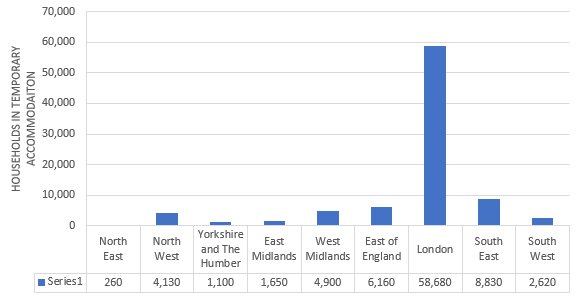
In 2019, 88,330 households in England found themselves living in temporary accommodation, a figure tragically up from 48,010 in 2010. That is equivalent to the size of a town like Grimsby, Guildford, or St Albans often having to live in bed and breakfast accommodation in the first instance, until something more suitable can be found.
Figure 1: Total Number of Households in Temporary Accommodation 31st December 2019
The Tories have at least attempted to unwind the horrendous consequences of their own bad policy through reforming “no fault” evictions, removing Section 21 of the Housing Act 1988, and making changes to the grounds for possession. Yet much of this will be a mere sticking a plaster over what are much deeper structural issues, with pressure on the housing benefit system having been exacerbated from years of weak wage growth and domestic price rises
The severity of the impact on households’ living standards has been to an extent normally associated with a severe recession, which has left the huge shortfalls between LHA and the true cost of renting one borne by the poorest. The result has left the country ill-prepared to face such a crisis, particularly as it braces itself for the biggest economic slump in over 300 years. This was not what Labour had it mind when it introduced LHA back in 2008 following evidence based research.
After an initial three-year pathfinder Labour set the LHA rate at the median 50th percentile of the local private market. Shared Accommodation Rates were applicable for those under 25, which meant that single claimants under 25 were forced to share with others rather than live on their own. It had an aim to give a flat fair allowance for the local area and enabled people to have choice. LHA was argued to increase incentivisation to work, namely through greater clarity of in-work benefits, and most importantly it was simple.
LHA was slashed in 2011 to the 30th percentile by the Coalition government, with the Liberal Democrats crooning it in, like mice singing in the cats choir. A year later LHA rates were delinked from market rents and increases there forth capped by CPI. An uncaring cap on benefits was further introduced in 2012 following George Osborne’s famous Conservative Party conference speech where he asked “where is the fairness?”.
Three years later George Osborne thought it was still not fair enough and pushed the benefit cap even lower in his Summer Budget of 2015. He brought this alongside an extension of SAR up to the under 35s, with a 5-year freeze to LHA announced in 2016.
Turns out George’s idea of “fairness” leaves poor families with mounting debt and pushes children into deeper poverty, with many families financial circumstances having worsened following the introduction of the policy. In large part having been left with an average gap between rent and housing benefit of £3,750 per year.
That said, evidence from Crisis identified that investing in LHA rates to cover 30% would prevent 6,000 households from becoming homeless over a three year period. It would also lift 32,000 households out of poverty, which would include 35,000 children. Off the back of this research, and vociferous campaigning by Labour Party politicians the Tories buckled, and ended their very own LHA freeze one year early.
Hurrah!
Announced in January 2020 under The Social Security (Coronavirus) (Further Measures) Regulations 2020 the Government stated it would relink the LHA to the 30th percentile, which was set at the same level seen in the 2019 Labour Party manifesto.
But was this rate high enough?
The Liberal Democrats thought not. Their manifesto included a call to increase LHA in line with average rents in an area. Though fell short on whether this was the mean average, or the more robust to statistical outliers mean average. In any case nobody was going to believe that commitment with the Liberal Democrats having been the hand maiden for such cuts in the first place.
Yet their policymakers did have a point, as a move back to the average rent level for LHA is one backed by credible research. In August 2019 Crisis demonstrated a higher cost benefit could be achieved if LHA was restored to the 50th percentile rate in areas where the rates fall behind rents the most, and to 30th percentile everywhere else. The research also gave a nod to restoring all the rates to the cheapest half, which would bring the highest overall benefit. In effect restoring LHA to the progressive median average, not seen since the last Labour government, would be more equitable and more cost effective.
This begs the question why previously Labour only sought an increase to the 30th percentile when, under the previous Labour Government, the median average left fewer people choosing between eating or paying rent. Shelter have recently joining the ranks call for an increase in housing benefit to cover the cost of average rents and to lift of the benefit cap.
Labour’s recent announcements chime well. Thangam Debbonaire’s emergency five-point plan echoed such calls through laying out increases to LHA rates and an improved provision of Universal Credit. Shadow Secretary of State for Work and Pensions, Jonathan Reynolds, also called for urgent action on social security. Through a suspension of the benefit cap and removing the savings and two-child limit to Universal Credit.
At least now renters can take comfort both Labour and the experts are on their side.
Sadly, the Tories will be difficult to move on from the below average LHA rate and age discriminatory SAR policy, which will remain unfair and incredibly impudent towards those on the breadline. Yet Labour must continue to be bolder than its Tory counterparts on housing. For it to work effectively for a just society, it must call for an increase in LHA to the median 50th percentile rate, not the mean, and in the interest of fairness push for the abolishment of age discriminatory housing benefit criteria.
Chris Worrall
Co-Editor of Red Brick. Non-Executive Director of Housing for Women. Labour Housing Group, Executive Committee. Exploring innovative new models in housing with care in the for Guild Living. Previously Investment and Finance Manager at Quintain and Thor Equities.
The Covid-19 pandemic has exposed the scale of rough sleeping across the UK, particularly in London, and the crisis continues to create more street homelessness. But it also creates an opportunity to end it.
The government’s letter to local authorities on 26th March telling them that they needed to tackle rough sleeping by getting “Everyone In” by the end of the week was, at best, not backed up with adequate resources. At worst, it betrayed a real lack of understanding of how entrenched homelessness is in London and how many people with only precarious housing have been pushed into street homelessness as a result of the current crisis.
Rough sleeping didn’t start with Covid-19. On the government’s own figures, street homelessness in England spiralled from 1768 people in Autumn 2010 to 4677 people in Autumn 2018. The cap on local housing allowance that meant some areas had quite literally no private rented homes available to those claiming housing benefit didn’t help. Plus, many rough sleepers have been denied the help they need up to now because they were No Recourse to Public Funds (NRPF) due to their immigration status.
Even in the current lockdown, homeless outreach teams in London are still reporting new arrivals to the street. The reasons are numerous and complex, but it exposes how many people in the capital live in unstable accommodation. The Magpie Project has reported an increase in mothers and children who were previously “sofa-surfing” becoming homeless. Moving between different sets of friends on different nights is not easy under the current lockdown, neither is staying in a dormitory room in a backpackers’ hostel. Those with NRPF status or fleeing domestic abuse are often reluctant to seek help and may choose to remain hidden.
Huge efforts have been made by the GLA and local authorities to get everyone into safe accommodation. The immense talent and energy of the voluntary, community and grassroots sector has been invaluable. In their recent submission to the Housing, Communities and Local Government Select Committee’s Inquiry into the Impact of Covid-19 on homelessness and the private rented sector, the Museum of Homelessness comment that “The explosion of mutual aid groups has shown there is significant public appetite to help the most vulnerable and the Government should take note of this. The crisis has brought the deep inequalities in the UK to broader public attention.” In Islington, a covid-19 homelessness taskforce works out of a council community centre preparing and distributing food to the borough’s homeless residents currently in temporary accommodation.
But little has been said up to now about medium or long term plans to help people into secure accommodation when the current crisis ends. The immediate need is to ensure that everyone currently placed in emergency accommodation has an ongoing offer of support including permanent housing options. The long-term strategy also needs to recognise that there is a continuing flow of people being made street homeless by the current crisis and all recently set up emergency options need to stay open.
On 2nd May we heard about a new government taskforce to work with councils “to ensure rough sleepers can move into long-term, safe accommodation once the immediate crisis is over…” But now it has also emerged that government funding for the “Everyone In” policy is to end. What measures will this new taskforce put in place and will it actually address the two key issues – a lack of stable long term funding for local authorities and a lack of genuinely affordable homes?
A national Housing First programme would make for an effective long-term strategy. Born in New York in the 1990s and rolled out nationwide in Finland, Housing First offers an unconditional home to vulnerable rough sleepers together with a package of wrap-around support. Amsterdam’s Housing First service reported in 2013 that 97% of the high needs homeless people who were using it were still in their homes after 12 months. Copenhagen’s programme had a 94% success rate. Canada’s At Home/Chez Soi project found that over two years Housing First participants “achieved significantly greater housing stability, quality of life, and community functioning…” than those on more traditional housing and treatment pathways. It’s also something that we’ve piloted in Islington with five of our own council homes. But for Housing First to work, we first need enough genuinely affordable homes.
What’s more, the government’s flagship First Homes policy suggests that homes for sale discounted by up to £100k will be built through s106 planning agreements, a mechanism that is normally used in London to ensure that social housing is built. Any policy that requires planning agreements to include discounted homes for sale will mean fewer new homes for social rent, and, ultimately, lead to more homelessness.
Lubetkin, the architect responsible for Islington’s Spa Green Estate and Bevin Court, summed up the spirit of post-war council home building with his maxim that “nothing is too good for ordinary people.” Could a national Housing First programme combined with a national building programme of genuinely affordable homes become the 2020 incarnation of this dream? The work done so far presents the opportunity to end homelessness for good, we shouldn’t waste it.
Diarmaid Ward
Diarmaid Ward is a Labour Councillor and Executive Member for Housing and Development at the London Borough of Islington. He has previously written for CityMetric, CapX and Inside Housing.
Let’s face it: we, as a country, have royally screwed up on housing. Decades of bad policy, bad ideas, and sometimes even bad faith, have led us to one of the worst housing crises in Europe.
We’ve finally reached a stage where almost everyone accepts that there is a problem and that the cost of housing is simply too high. Unlike almost every other type of product or service money can buy, the price of housing to buy or rent has gone up in real terms. Young people are spending tens of thousands of pounds more in rent throughout their twenties than earlier generations did, and their likelihood of becoming homeowners has plummeted.
It has also become more widely accepted that one of the key causes of this is that we have, for decades, failed to build enough homes. Study after study after study after study has demonstrated that supply is a key determinant of housing affordability. Social housing has particularly strong and well-targeted affordability benefits, but it extends to all types.
One of the things that has amazed me since getting involved in the YIMBY movement is the broad political spectrum of the people it attracts. PricedOut enjoys the support of committed socialists, steadfast centrists, and outspoken neoliberals. More or less anybody who looks in detail at the housing crisis will eventually conclude that there simply isn’t enough housing. I’m not sure many other ideas have such widespread backing.[1]
We must be very careful to keep it that way. Although they might make different arguments, anti-development NIMBYs (“not in my back yard”) can be left- or right-wing. NIMBY talking points run the gamut: the simple self-interest of preserving high property values, heritage preservation, a somewhat misguided understanding of environmentalism, or even the old classic “we don’t want people like that moving here.”
I’ve sometimes been surprised to meet people who see themselves as progressives lobbying against new development. This is often couched in anti-gentrification terminology and focuses on the fact that the new homes are too expensive. It is absolutely true that new homes are too expensive. That is because all homes are too expensive, because they are in short supply, and land values are accordingly high. New homes are built to more modern standards than our shockingly aged housing stock. They are also inflated by government policies like Help to Buy and therefore attract a premium.
Imagine you had a village of 100 homes, and 100 households. People move around between these homes periodically. The child of one of those households, a high-earner, grows up and is ready to move to her own place. If there isn’t a 101st home, she will simply outbid a poorer household on a home that becomes available. That poorer household will be forced to leave the area, or share with another. Pretty soon the area becomes “gentrified”: having higher rents, relatively more high-earning households, and any low-earning households will live cramped together. If that sounds familiar, you may live in London. The conclusion is of course that you don’t stop gentrification by not building the homes, you stop it by building them.
This is especially the case given that the supply of social housing is largely dependent on supply of private housing. About half of new affordable housing in England is delivered as part of a planning obligation. These are agreements, as part of a planning permission, between councils and developers that a certain proportion of new homes will be affordable. Additionally, affordable housing developers will generally cross-subsidise new social homes through profits generated from private sale homes. It’s unfortunate that this process is sometimes accompanied by hand-wringing and portrayed as a necessary evil, or outright attacked as a “loss of social purpose”.
For the reasons discussed above, developing private homes is agood thing. That is not to say that we don’t need drastically more government funding for social housing, because we absolutely do. But you can get more bang for your buck by cross-subsidy, and we need more of all types and tenures of housing. Having varied types of housing on one scheme also gives developers a real incentive to build the homes faster, because they don’t have to worry about loads of one type of home flooding the market at once.
It is fortunate, then, that market and social housing are not at odds in the UK. I suspect this is part of the reason we can attract such a broad spectrum of support for PricedOut. It also helps to explain one of the things our planning system is really good at: avoiding massive mono-tenure estates. I met a housing campaigner from San Francisco last year who was amazed to find beautiful social housing estates right in the middle of central London, opposite swanky executive pads.
To him it was unthinkable that poor and rich neighbourhoods weren’t totally separated. It’s widely observed that poor people get poor services: worse access to healthcare, fewer free services, and sometimes few amenities at all. But it’s much harder for this to be the case when poor people live in the same neighbourhoods as richer people, which I think tends to be ignored in the gentrification debate (poor people like nice things too!).
My surprised San Franciscan friend was even more surprised to learn that UK Yimbys tend to support the development of social and market housing, and that they were not opposing goals under our planning system. In California, it seems that the more market-orientated Yimbys find themselves opposed to “Phimbys”: proponents of “public housing in my back yard”, who lobby against private developments in favour of affordable housing. The resultant gridlock probably helps in part to explain why San Francisco is one of the few places with a worse housing crisis than we have.
It is to our benefit that we don’t have this problem, at least to that extent. But as I’ve mentioned, it’s not unusual to see apparently progressive people baulk at the notion of increasing housing supply. Sometimes this counterproductively leads them to oppose developments. Sometimes, to my shock, it even leads them to oppose majority social housing developments such as the Old Tidemill Garden in Deptford, which has fortunately gone ahead despite some aggressive opposition.
Yimbyism’s strength lies in its strong evidence base , which allows it to attract support from across the political spectrum. At PricedOut, we want to preserve this. It’s essential that we don’t allow Yimbyism to become too heavily associated with either end of the spectrum, lest it become captured by that movement and anathema to the rest. This means we need to be very clear that opposing the development of new homes, private or otherwise, is not progressive.
PricedOut is England’s national campaign for affordable house prices. We call for action from government to build more homes and reduce the cost of decent housing. We fight for everyone who wants to be a homeowner but can’t afford to, and everyone who wants to move closer to work or amenities but can’t afford to.
Anya Martin
Anya Martin is Head of Policy at PricedOut, England’s national campaign for affordable house prices. She also works as a researcher within the social housing sector where she has published on a range of topics including housing supply, welfare, and low pay employment.
The UK has entered and will leave this pandemic while experiencing a decades-long housing shortage. The country will soon begin to repair the harm done to the economy and society by this disease, but it cannot continue to afford this housing crisis. The inequality it fuels and the damage it causes to national and local economies are too great to bear. We cannot go back to how things were before.
At its core, ending the housing shortage requires more homes. But where new homes are built matters. Yet at present, not enough houses are built in some cities, and arguably too many are built in others. This mismatch emerges as the design of the planning system means it rations the supply of land available for new homes. Ending the housing crisis will therefore require reform of the green belt and a new, flexible zoning planning system to build enough new homes.
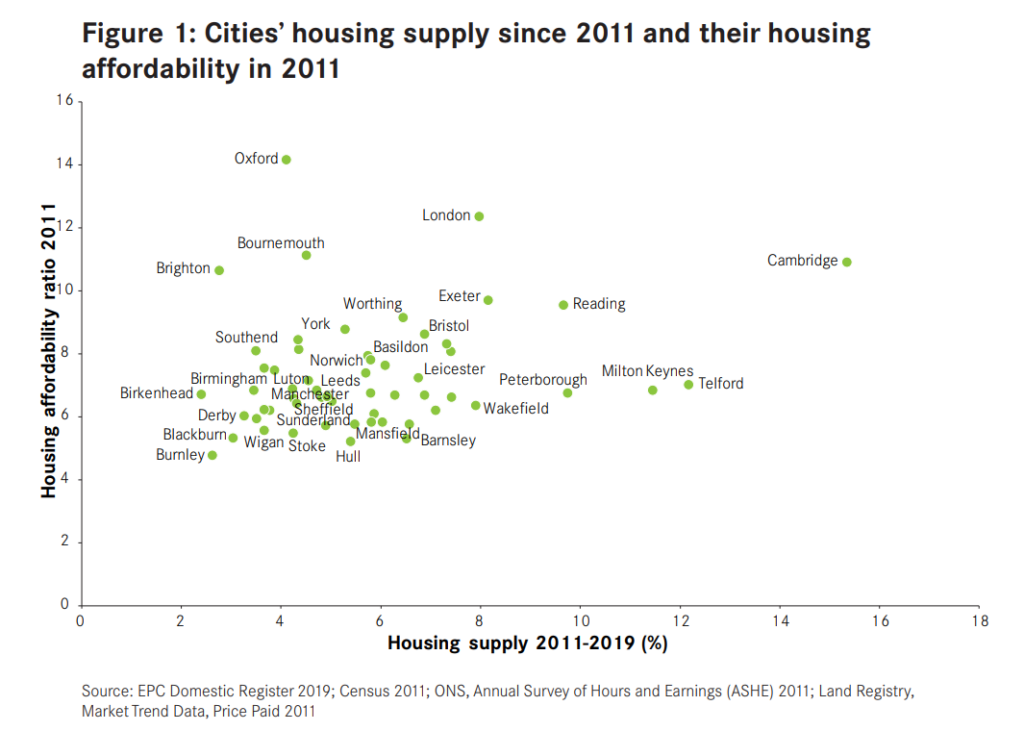
So solving the housing crisis therefore requires a focus on the most expensive cities with the worst affordability problems. But currently, as Fig. 1 below shows, there is no link between cities’ demand for housing and their supply of new homes. Many expensive cities including Oxford and Bournemouth are building far fewer homes than those which are more affordable such as Wakefield or Telford. The supply and demand of new homes have been disconnected.
Source: EPC Domestic Register 2019; Census 2011; ONS, Annual Survey of Hours and Earnings (ASHE) 2011; Land Registry, Price Paid Data 2011
The planning system disconnects local housing supply from local demand
This decoupling of supply from demand originates in the planning system, as the amount of land it makes available for housing is rationed. Development of new homes normally cannot proceed unless the council decides at their discretion to grant a planning permission to a site. Measures such as the green belt block new homes across large areas of land adjacent to many cities and railway stations, including Bristol, Newcastle, Manchester, Birmingham, and London.
The rationing of land, not prices or affordability or need, ultimately decides how many houses cities build. It explains why some cities which have low demand build more than the average city, and far more than some very unaffordable cities.
The planning system prevents redevelopment in large parts of the existing suburbs
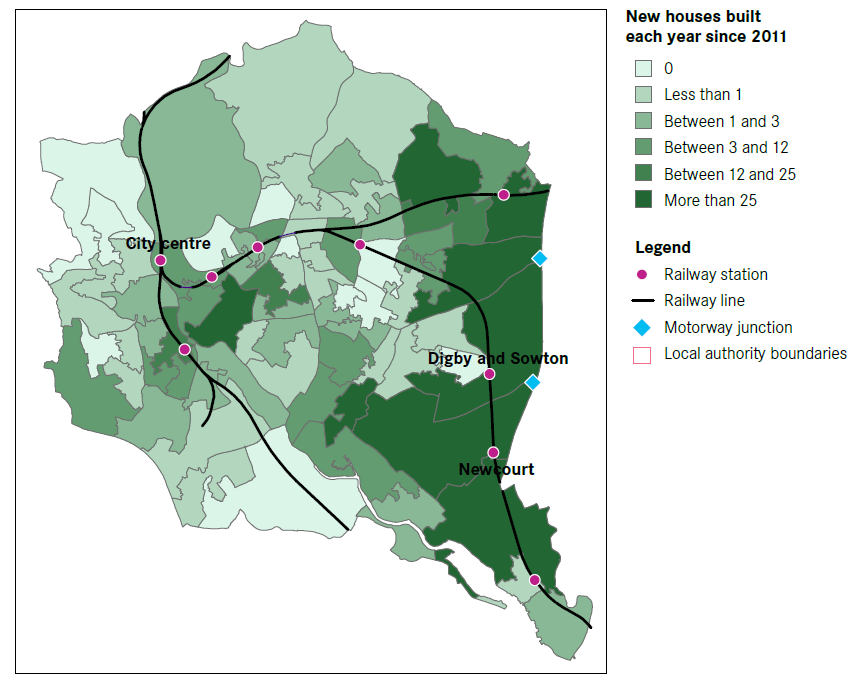
The planning system’s rationing of land can be seen in how it warps the supply of new homes within cities. Consider Exeter, an expensive city which is building lots of new homes above the average rate for cities, in Fig.2 below. A substantial number of homes have been built in the city centre (8 per cent growth since 2011), and there is a cluster of new homes being built on the eastern outskirts of the city, including near the brand new railway station of Newcourt.
Fig. 2 Housing supply in Exeter from 2011-2019
Source: EPC Domestic Register 2019; Census 2011
Nevertheless, 48 per cent of suburban neighbourhoods in Exeter are building less than one house a year. 14 per cent of suburban neighbourhoods in Exeter have actually built no new houses over this period, including a built-up area close to Digby & Sowton station. Even though Exeter has built lots of new houses, the amount of land which has been made available for development has still been subject to rationing.
This national pattern across cities emerges from the design of the planning system. As the supply of new homes is controlled by the discretionary granting of planning permissions by elected councillors, it is both uncertain for developers to navigate and sensitive to political pressure from anti-housing activists. The result is that as so much of the suburbs and unremarkable green belt land are off-limits to new homes, new housing supply is forced into easy-to-develop pockets on the outskirts of cities, and pressure for redevelopment is put on city centres and locations such as social housing estates and offices into flats.
Local shortages which emerge from the planning system make inequality worse within and between cities
By stunting the supply of housing in expensive cities, the planning system creates two different inequalities.
First, it drives inequality in housing costs within prosperous cities between renters and homeowners. As rents rise due to the shortage of homes, so does the wealth of homeowning neighbours as through their housing equity.
More building by councils and housing associations can play a large role here. However, the root cause of the housing crisis lies not in a specific lack of social housing but in the institutional design of the planning system. For instance, England still has one of the largest social housing sectors in Europe, at 17 per cent of all housing stock, yet it also has one of the continent’s most dire housing crises.
Ultimately, the design of the planning system must change. Building more homes in the most expensive cities will require a shift from its discretionary model towards a flexible zoning system, as in Japan and certain US cities.
This approach, where planning permission legally must be granted if a proposal complies with a national zoning code and national building regulations to ensure the structures are safe, is compatible with more social and council housing. But it would fix the institutional problems the private sector faces by reconnecting local supply to local demand, and end the housing crisis by building more homes in the least affordable places with the greatest need.
Anthony has also worked on research on commercial property in cities, services exports, productivity, and manufacturing. He also has a particular interest in lessons for planning, housing, and UK cities from Japan and the countries of the former Soviet Union. Previously he worked at the Fawcett Society as a Research Officer.
The Fire Safety Bill has passed its second reading in Parliament but not without bringing the fears of multi-occupancy residents back to the centre of the housing safety conversation.
The bill seeks to amend the Regulatory Reform (Fire Safety) Order 2005, to clarify which parts of buildings are covered by requirements to manage and reduce the risk of fire by responsible owners. Whilst the bill makes necessary changes to fire safety law, it does not go far enough to meet the Government’s pledge to prevent another Grenfell Tower tragedy.
The Housing, Communities and Local Government Committee has published the findings of a survey into the progress of remediation work to improve fire safety in residential buildings.
The survey found residents continue to face bills of thousands of pounds for remedial or safety measures for a range of issues including combustible cladding, inadequate fire breaks and timber balconies or walkways. It also found that out of 1,352 respondents, 70% said they still had combustible cladding on their building.
Residents of multi-occupancy households have called on the Government to go further in its efforts to improve fire safety. Further to the £1 billion Building Safety Fund announced in the 2020 Spring Budget, residents have called for a pledge to ensure that all forms of dangerous cladding be removed and other safety defects dealt with.
During the 2nd reading of the Fire Safety Bill, I raised concerns of a constituent who had expressed fears to me regarding a tower block in a neighbouring constituency that was covered in combustible cladding which the landlord was refusing to remove.
The survey conducted by the HCLG committee has given us an insight into the reality of the fear thousands of people face across the country following the Grenfell Tragedy. As we have seen in the previous three years, where a loophole exists some will exploit it, despite the risk posed to residents.
One respondent to the survey said:
“I have highly flammable insulation, missing fire breaks, missing compartmentation, poorly fitted fire protection to the structural steel and poorly fitted fire doors. I fear for my life on a daily basis.”
As many raised during the Fire Safety Bill debate, the Government needs to do much more to ensure the safety of residents in multi-occupancy residences. Like many colleagues pointed out in the debate, the Grenfell Tower tragedy was one that should have been avoided.
As part of my role on the HCLG I will be continuing to hold the Government and industry to account over its failings to support residents in feeling safe in their own homes, so that we never have to experience such a devastating and preventable loss of life again.
Abena Oppong-Asare
Abena Oppong-Asare is the Member of Parliament for Erith and Thamesmead. She was elected as MP in December 2019 and has since been appointed to the Shadow Treasury Team as PPS to Anneliese Dodds.
Abena also sits on the Housing, Communities and Local Government Committee with specific interests in affordable housing and local government funding.
Red Brick was set up in 2010 as a place for progressive debate around housing issues. Ten years in, after 800 blog posts, it has a new web location, a revamped design, a new editor, and there are ambitious plans to increase the number of contributors.
The challenge is the same: we stand for decent affordable housing for all but there are many and various ways to get to that goal and many people have a contribution to make to the debate. We scrutinise every step of Tory policy and almost always find it wanting.
Covid has exposed how weak our housing system is. Despite the fact that it costs a fortune, much of it is spent in the wrong ways, subsidising demand and not supply, supporting one tenure at the expense of the others, failing to meet the most dire housing need. Solutions are possible – Labour’s Manifesto for the 2019 Election contained many of them – but we have to work them out in detail and make sure the public is aware of them.
One thing seems certain: housing will be an even bigger and more desperate issue after Covid. More people are fleeing domestic violence, more people are facing rent arrears and eviction, social housing is being deprioritised even further. There may be huge disruption in the housing market as the financial implications work through. It will be a time where clear analysis, workable policy proposals, and effective campaigns are needed more than ever.
Red Brick blog is linked to the Labour Housing Group but is editorially independent. Ten years ago, we chose the strapline ‘The Place for Progressive Housing Debate’ because we welcome all contributions and, whatever our individual views, Red Brick has no factional inclinations.
Except we’re not very keen on Tories or Tory solutions!
We are happy to publish both sides of an argument and to enable all opinions to be voiced. However, we celebrate diversity, are steadfastly pro-equalities and against discrimination in any form.
I hope you will continue to read and value the blog so it can continue to contribute in a small way to progressive housing debate. It would be even better if you contributed – just pitch your idea to us, we’ll be happy to help you to put it together for publication.
Thanks to Chris Worrall, Sheila Spencer and Ross Houston from the LHG Executive for the work they’ve put in to make this transition happen. LHG shows signs of a real resurgence as a membership and campaigning body within Labour, which can only be a good thing.
Thank you for reading Red Brick over the last decade and I hope you will continue to do so for years to come.
Rose Grayston
Rose is editor of Red Brick. She has worked to develop and win support for solutions to the UK’s housing crisis as Expert Adviser to Matthew Pennycook, Minister for Housing and Planning, as a Labour activist and founding member of Open Labour, and through roles at Shelter, the New Economics Foundation and Generation Rent.
Steve Hilditch
Founder of Red Brick. Former Head of Policy for Shelter. Select Committee Advisor for Housing and Homelessness. Drafted the first London Mayor’s Housing Strategy under Ken Livingstone. Steve sits on the Editorial Panel of Red Brick.
Much as in the UK, the past few weeks in Australia has seen housing policy innovation and emergency expenditure on a remarkable scale. State governments that have historically treated street homelessness as a low priority issue have suddenly found tens of millions of dollars to create pop-up accommodation or book rough sleepers into hotel rooms. Since March literally thousands have been rescued into temporary shelter.
Similarly, panicked by the vision of abrupt mass unemployment triggering a new homelessness crisis, state governments across the country have legislated evictions moratoria.
Federal government has also bolstered the ability of households to meet their housing costs, through the crisis by temporarily doubling the rate of the normally miserly Jobseeker unemployment benefit, and introducing a temporary Jobkeeper wage subsidy to help struggling employers retain staff.
But the need for such short-term fixes also highlights the entrenched failings of Australia’s housing system. This crisis has laid bare five major vulnerabilities.
The need for short-term fixes highlights the entrenched failings of Australia’s housing system. Read how this crisis has laid bare five major vulnerabilities in the latest #redbrickblog
1. Street homelessness has become a significant problem
Before the pandemic, street homelessness in Australia was affecting about 8,000 people on any given night, as indicated by census data, and up 20% in the last five years. But this is almost certainly an underestimate.
Recent UK research showed the number of people sleeping rough in any given year was five times as many as captured in census-type snapshots. There’s no reason to think it’s much different in Australia. And many more people are on the fringe of street homelessness — couch surfing, for example.
2. More than a million pushed into rental stress
Australia’s second housing system vulnerability is the body of people – far larger again – living in insecure and unaffordable rental housing. Even before this current crisis, unaffordable housing costs had pushed around 1.3 million into poverty. After paying rent they didn’t have enough money left for essentials like food and electricity.
Now many of these renters will have lost jobs or work hours. Government schemes like JobKeeper and JobSeeker will temporarily help only some — temporary migrants and many casual workers are excluded.
Measures like the moratorium on evictions are welcome (provided they prove robust). The same goes for mortgage pauses by the banks, which might help property owners avoid having to sell if tenants can’t afford the rent.
But these are only stopgap efforts.
3. A shrunken social housing sector
The third vulnerability is the shrivelled state of Australia’s social housing, a sector only a quarter the size of its UK counterpart. With virtually no new construction for most of the past 25 years, stock levels have flatlined. Proportionately, it has shrunk from 6% to a meagre 4% of all housing. More importantly, relative to population, the number of properties let by public housing agencies and community housing providers has halved since 1991.
Across most of Australia, waiting lists for social housing are huge. In most jurisdictions the sector lacks the capacity to offer long-term housing to all the rough sleepers and others currently in hotels. Other than through emergency unit acquisitions or head-leasing of privately owned properties, it is hard to see how this will be possible.
4. A mountain of debt
Australia’s fourth housing system vulnerability is the scale of housing-related debt. If the pandemic-induced downturn persists and unemployment stays high, this could make the recession much worse.
In the early 1990s household debt equated to about 70% of disposable household income. In March 2019, the Reserve Bank of Australia warned the debt-to-income ratio had risen to 190%. The increase was mostly due to increased borrowing to buy homes and investment properties.
Even before the pandemic, one in five mortgage holders were struggling to meet repayments. If large scale unemployment were to force mass property sales, this could compound the crash as homes flood the market. Given that Australian banks are more highly exposed to residential property than their counterparts in other OECD countries, this also poses a wider financial risk.
We know from the GFC experience in the USA, Ireland, Spain and elsewhere that a sharp fall in property prices can have severe and long-lasting economic consequences that worsen inequality. In the USA, vulture landlords stepped in to buy up large numbers of distressed properties and create rental property empires. Renting from owners of this kind is not an attractive prospect.
5. An unbalanced housing system
Australia’s housing system is vulnerable to shocks because – much more than in the UK – it is unbalanced, our fifth system frailty. Residential construction depends almost entirely on private developers building for sale to individual buyers.
These buyers are highly sensitive to the outlook for property values. The resulting herd mentality magnifies booms and slumps – a particular problem when they are totally dominant in the market. A magnified downturn can bring residential construction to a grinding halt. And while quick to shed labour, construction is slow to re-employ because of risk and long project lead times.
Construction normally employs more than 1 million Australians with a range of skill levels. It generates many more jobs through the building materials supply chain as well as in real estate, property management and financial services. This helps to explain why the traditionally antagonistic Master Builders Australia and the building union CFMEU have united in a call to government to invest in building 30,000 social housing units as part of Australia’s post-COVID recovery.
The need for a national strategy
Australia’s housing system needs more than a one-off crisis boost. The pandemic policy jolt is an opportunity to put Australia’s housing on more stable footings through a Commonwealth-led bipartisan, long-term, national housing strategy.
A key part of this should be routine social housing construction on a scale that at least keeps pace with population growth. That’s up to 15,000 homes a year – around five times the current number. This may sound ambitious, but it’s below the levels regularly achieved between the mid-1950s and the mid-1970s.
And this doesn’t have to mean a return to the post-war approach when state authorities provided public housing. Not-for-profit community housing organisations can now take on the major new supply role.
But we do need a post-war level of ambition. Government has two immediate roles to play in linking housing to a post-pandemic recovery.
The first is to help avoid a house price crash that will deepen an economic slump. Co-ordinating action with mortgage lenders could help minimise repossessions and avoid a glut of discounted properties on the market. Governments may also need to take on distressed projects from private developers. The New South Wales government has already flagged such action.
The second immediate role for government is to support residential construction as the motor of economic revival by investing in social housing as the central plank of a stimulus package. Government-owned sites and developer-owned landbanks can be used to kick-start activity more quickly than other major infrastructure projects. Community housing providers – especially some larger faith-based players – also have shovel-ready sites.
These should be the prelude to a national housing strategy, something that has been – remarkably – absent in Australia since 1945.
A key strategic objective should be to diversify both housing supply and demand. Alongside a greater role for community housing providers, this could include a build-to-rent sector commissioned by institutional investors to build market rental blocks as long-term, income-generating assets. This development – currently impeded by tax inequities – would benefit tenants and the economy, by smoothing the boom-bust cycle of residential construction.
As we argue in our recentbooks, a national housing strategy must also thoroughly overhaul national, state and territory tax settings. Many of these have greater housing policy impacts than any spending program.
Reform of this kind – especially to phase down the vast and untargeted tax subsidies enjoyed by small-scale landlords, and to replace stamp duty with a broad-based land tax – could make Australia’s housing system both fairer and more efficient. It could dampen the speculation that fuels rising prices and debt, while raising the revenue needed to provide decent, affordable housing for all Australians.
This is an edited version of an article that originally appeared in The Conversation (Australian edition). Read the original article here.
Hal Pawson
Hal Pawson is Professor of Housing Research and Policy at the University of New South Wales, Sydney. He retains a Visiting Professor position at Heriot-Watt University, Edinburgh where he was based until 2011. He is also an associate of Sheffield University’s Department of Urban Studies and Planning, and a Managing Editor of the international journal, Housing Studies. His latest co-authored book ‘Housing Policy in Australia: A case for system reform’ was published in 2020.