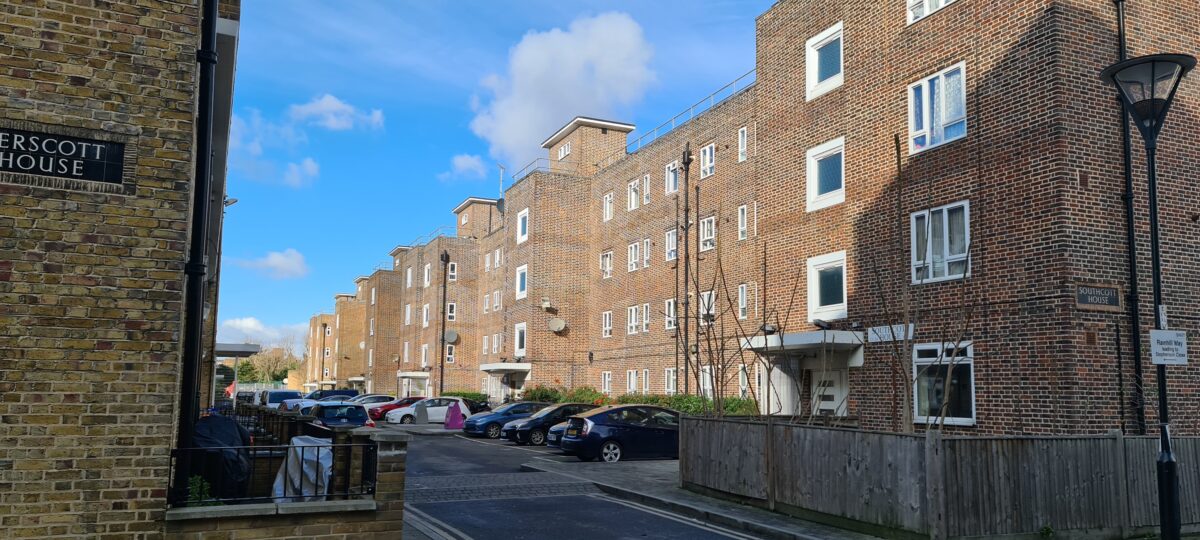
“My belief is that your postal code does not determine your worth, value, or capabilities. However, when it feels as though where you call home isn’t worth investing in, people can lose their feeling of connection and their sense of value in ‘place’, subsequently disengaging completely. Through meaningful regeneration, residents in areas in the Gleadless Valley can look across the city and see a real, achievable future before them. A future that, by investing in their roots, can give them hope to grow.”
These are the words of Lara Joyce, Secretary of the Gleadless Valley Resident and Tenants’ Association, taken from the perspectives article she wrote for the Northern Housing Consortium’ s (NHC) Renew inquiry into housing-led regeneration.
A few weeks ago, Lara showed myself and members of the South Yorkshire Housing Partnership around her local area as part of one of our Renew site visits. Lara shared how the Gleadless Valley was held up as an architectural triumph when it was first built. More recently, however, it has become one of the UK’s 10% most deprived areas. Change has been promised since 2017 but never materialised, leaving residents frustrated and disillusioned. Now, through the efforts of involved residents like Lara working alongside dedicated council officers, trust is slowly being rebuilt, and at last there is hope. At the end of 2025, the ‘Vision for the Valley’ (developed with residents like Lara) was approved by Sheffield City Council. A community-led approach to reporting and managing fly tipping, anti-social behaviour and street maintenance is being rolled out, alongside a new park, signalling change is finally coming. Longer-term plans include over 1,000 new homes, refurbishment of existing properties, and improvements to community amenities and transport, although funding is not yet confirmed for all elements.
On the site visit, Lara told us:
“I want kids from this estate to look across the city and see a real, achievable future before them, a future that, with investment in their roots, can give them hope to grow.”
The wheels are certainly in motion for Lara’s vision to become a reality. However, Lara and the Gleadless Valley residents are not alone. There are lots of other communities in similar situations across the North, and we must make sure no one and nowhere is left behind.
Why regeneration needs government support
Hearing Prime Minister Andy Burnham talk about regeneration as one of his top priorities offers hope. We have also seen action: additional flexibility in the Social and Affordable Homes Programme (SAHP) to support regeneration, the National Housing Delivery Fund, the Pride in Place initiative, and the Northern Growth Strategy all promise investment in the North’s cities. Deepening devolution through Rewiring of the State should give local leaders more flexibility to address local priorities, and is something the NHC has advocated for consistently for years.
However, whilst housing-led regeneration undoubtedly brings substantial benefits to local communities and economies, it is extremely challenging to deliver in the North. With lower land values and high remediation costs, many schemes are simply not viable without Government support. Many successful schemes I’ve seen have only gone ahead because social housing providers have pooled multiple funding streams and invested their own funds at levels that just wouldn’t be sustainable on a larger scale.
Our Renew report, Unlocking 500,000 homes in the North, was based on evidence from providers who own or manage 70% of the North’s social housing. We found that in many areas of the North, housing-led regeneration is an essential part of delivering new homes and making sure no one and nowhere is left behind.
Making existing funding work harder
There are some simple measures the Government can take now to make housing-led regeneration on estates, in town centres and on brownfield land more achievable. The Government has already pledged to give Mayors more control over SAHP funding. Giving Mayors greater flexibility to fund council and social rent homes, through Continuous Market Engagement, without a cap on regeneration activity, will help them address the housing needs in their local area. Specific KPIs for Homes England around regeneration would also help. At the moment, all Homes England’s KPIs are still around new supply, despite it being the Government’s housing and regeneration agency.
An allocation of National Housing Bank funds for housing-led regeneration would help schemes progress. Extending the National Housing Delivery Fund to ten years would also have a significant impact. We estimate this would allow all of the North’s brownfield land to be remediated, unlocking 320,000 new homes.
Whilst these changes would be welcome, ultimately the substantial gap in support for regeneration can only be filled by a dedicated place-based fund. Our Renew inquiry recommends providing northern Mayors and combined authorities with £500m per year for 10 years in devolved, flexible funding as part of integrated settlements where they exist. This would empower Mayors to bridge viability gaps for strategically important schemes, and would significantly increase the capacity of social housing providers to replace or refurbish homes that have reached the end of their lives. Our research suggests this place-based fund would tackle the vast majority of the 100,000 end of life social homes in the North over the next decade. As well as ensuring thousands of people could live in better quality, healthier homes, this would also reduce repair costs and free up capacity to build more new homes.
Our Renew visits over the summer, have highlighted a piecemeal approach to regeneration, where social housing has been transformed but privately owned properties have been left untouched. Even in areas with high concentrations of social housing, privately owned and rented homes are pepper-potted around estates due to Right to Buy. Dedicated flexible funding would make it possible to buy poor quality private homes, including empty homes, and refurbish them into social housing, making a real difference to whole neighbourhoods.
A new National Centre for Regeneration in the North could spearhead investment in capacity, working closely with Mayors and combined authorities to drive forward regeneration and develop a workforce that’s ready to deliver.
Putting communities at the heart of regeneration
In the words of Lara Joyce, if we want regeneration to give people “hope to grow”, getting community engagement right is a must. The Renew site visits have shown the importance of housing providers and other partners working closely with communities, keeping them up to date and listening to and acting on their feedback. In the coming weeks, we have further work planned around community engagement to feed into policy development.
To unlock growth in every postcode and make sure no one and nowhere is left behind, we must act now on housing-led regeneration. It is the only way to make sure everyone has access to a safe, warm, home in a place they’re proud of.
The NHC is leading the Renew inquiry into housing-led regeneration for northern growth, supported by Homes for North and Muse. The inquiry is chaired by Lord Richard Best OBE DL and the Renew Westminster Group Chair is Andrew Cooper MP.
Would you like to write for Red Brick? Email rose.grayston@gmail.com to pitch your piece (c.600-900 words)